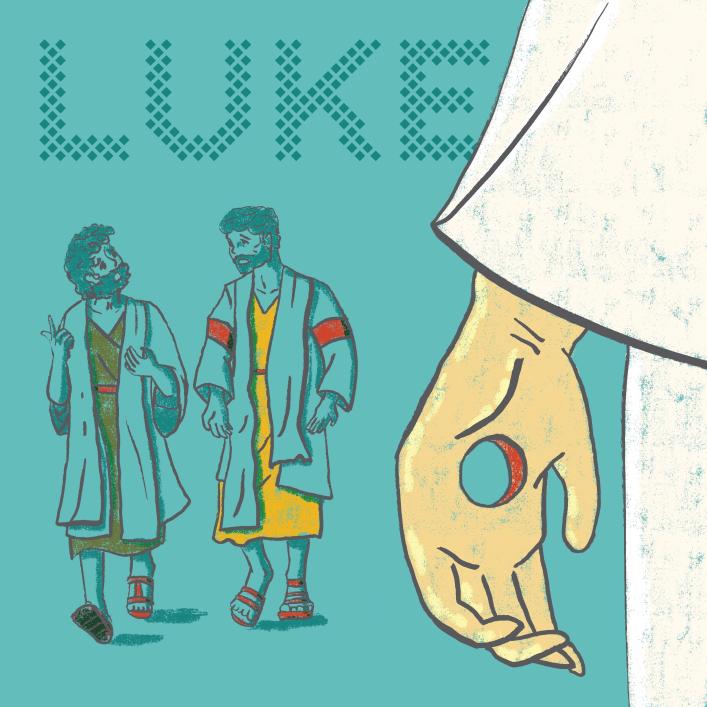
 The voice in the wilderness
 8 sermons


Let's turn to God's word now. We're going to be carrying on our series in Luke's gospel. And we come to chapter three, and Rory's gonna be preaching to us on verse one to 20. In the fifteenth year of the reign of Tiberius Caesar, when Pontius Pilate was governor of Judea, Herod tetrarch of Galilee, his brother Philip tetrarch of Iteria and Trachonitis, and Licenius tetrarch of Abilene, during the high priesthood of Annas and Caiaphas. The word of God came to John, son of Zechariah, in the wilderness.
He went into all the country around the Jordan, preaching a baptism of repentance for the forgiveness of sins. As it is written in the book of the words of the Isaiah the prophet, a voice of one calling in the wilderness, prepare the way for the Lord, make straight paths for him. Every valley shall be filled in, every mountain and hill made low, the crooked roads shall become straight, the rough ways smooth, and all people will see God's salvation. John said to the crowds coming out to be baptized by him, you brood of vipers! Who warned you to flee from the coming wrath?
Produce fruit in keeping with repentance, and do not begin to say to yourselves, we have Abraham as our father. For I tell you that out of these stones, God can raise up children for Abraham. The axe has been laid to the root of the trees, and every tree that does not produce good fruit will be cut down and thrown into the fire. What should we do then? The crowd asked.
John answered, anyone who has two shirts should share with the one who has none, and anyone who has food should do the same. Even tax collectors came to be baptized. Teacher, they asked, what should we do? Don't collect any more than you're required to, he told them. Then some soldiers asked him, and what should we do?
He replied, don't extort money, and don't accuse people falsely. Be content with your pay. The people were waiting expectantly, and were all wondering in their hearts if John might possibly be the Messiah. John answered them all, I baptize you with water, but one who is more powerful than I will come, the straps of whose sandals I am not worthy to untie. He will baptize you with the Holy Spirit and fire.
His winnowing fork is in his hand to clear his threshing floor and to gather the wheat into his barn, but he will burn up the chaff with unquenchable fire. And with many other words, John exhorted the people and proclaimed the good news to them. But when John rebuked Herod the tetrarch because of his marriage to Herodias, his brother's wife, and all the other evil things he had done, Herod added this to them all. He locked John up in prison. There we go.
On the mute. Good morning, everybody. My name is Rory. For those who don't know me, I'm one of the the members of Joy to be returning to this amazing book of Luke. So, let us pray as we begin our time together.
Father, we have just sung about our dear bridegroom, the lord Jesus Christ. We have sung that he is the fountain, the deep, deep well of love. And so we pray that you will help us to come this morning to that well, and that we may drink deeply of the Lord Jesus Christ. We pray, Father, that our eyes will not be on the glory of this world, but they will be on our dear bridegroom's face, the Lord Jesus Christ. Let us have eyes that want to see the king of grace, and not on the things that we may get from this world, but on the pierced hand of our lamb.
Let us revel in Jesus Christ. And so we pray these things in Jesus name. Amen. Amen. I'm sure you're familiar with stories or instances of times where people are seemingly destined for greatness.
It may be a young prodigy. It may be a child genius. And there's always the thought, could this person be somebody great? It may be a sports star, your favorite sports team, and one of the one of the young up and coming players burst onto the scene, and we think, could this be the next great player? Or it could be a a musician or an artist, and they they come up with one great album, and you think, what's next?
And then in time, we find out, don't we? Sometimes, they don't meet the expectations. Sometimes they're a one hit wonder, you know, and that's okay. We all know Rick Astley's one song, don't we? That came to mind then.
But some, they do. They reach the expectation. They sometimes exceed the expectations that are presented with a young age we were first introduced in the book of Luke to John the Baptist in chapter one You will remember that his parents Zechariah and Elizabeth were very old. They're really past the childbearing age. Yet Gabriel comes and announces to Zechariah, you're gonna have a baby, which was totally unbelievable to the fella.
And we saw in chapter one and verse 66, once this boy was born, he was called John. He'd had this amazing experience in the womb you remember when Mary came with a with a baby Jesus inside of her and John has a miraculous leaping of joy he's already in dwelt with the Holy Spirit it looks like this boy is destined for greatness, doesn't it? And so in 66 of chapter one, it says, everyone heard this wondered about it asking, who then is this child going to be? For the Lord's hand was with him. This here is a boy who looks like he's destined for greatness.
And then at the end of the chapter verse 80 after Zechariah sings this song, it says, and the child grew and became strong in spirit, and he lived in the wilderness until he appeared publicly to Israel. And so we're left with John, yes, growing in wisdom, yes, growing in his spirit, but going out to the wildness. And then we hear nothing often for another chapter until this one here. So what do we see in this passage? We're gonna see three things.
We're gonna see the prophet, the preach and the pointing. Desperate to get peas in there, can... As as you as you can see. But look with me firstly at the prophet, a voice of one calling. Verse one to six says, in the fifteenth year of the reign of Tiberius Caesar, when Pontius Pilate was governor of Judea, Herod Tetrarch of Galilee, his brother Philip Tetrarch of Iteria and Trachonitis, and Lysanias Tetrarch of Abilene, during the high priest of Annas and Caiaphas.
The word of God came to John, sort of Zechariah in the wilderness. If you've been following our series in Luke, you'll remember that Luke wants to take great efforts to presenting a gospel that is rooted in in the historical data. And so here is no different. You'll see that he's given us a load of different types of rulers that are in charge at this time. He's saying this is an event that happened in history, but he's not just showing us that it happened in history.
He's showing us what the social setting of the day was. He's revealing to us something of the political and the religious temperature of this day, and that is one that is pretty cold. It's a pretty dark world that we're presented with in the early part of chapter three. I mean, you just look at these characters that we're faced with. The first one, Tiberius Caesar.
If you know anything about Tiberius Caesar, you'll know that he wasn't the greatest of human beings that has ever existed. I think there was much rejoicing when Tiberius had gone from the scene. But then next person in in line is is Pontius Pilate. If you're familiar with your Bibles, we all know that it is this Pontius Pilate that condemns the innocent man that is Jesus to death on a cross. And then you've got these Herod's dynasty tetrarchs, all these people that were in the line of Herod's, and they're shockers as well.
I mean, you just need to find out about Herod at the end of the chapter, that he married his brother's wife, Herodias, which is a big no no in Jewish culture, according to God's law, and also, he does a load of other evil things. He's not a good man, and neither are the other bots here either. So there's the political scene. It's one of darkness. It's not hard to draw parallels between this political scene here today and the political scene that we see in our world, is it?
The darkness, the boasts of our leaders, the wanting and grabbing of the leaders that are around, the wars that are going on. But it's not just the political scene, it's the religious scene as well. Verse two, you'll notice that there's these two characters of the high priesthood of Annas and Caiaphas. If you know those two blokes, they also are complicit in the death of the Lord Jesus Christ. And they're part of a family.
Actually, Annas isn't the high priest at this time, but he's so got the high priesthood in his clutches that he's made sure that everybody in his family basically becomes the high priest. It's proper wicked nepotism. In other words, let's favor our own family. They're actually known as a... I might say this wrong because I already read it.
Saccadotal family. They're like a proper mafia. Like, it feels like Italian mafia, doesn't it? The Saccadotal family. Yeah?
No. You come into my temple. Anyway, that's what they're like. And they've kept the the priesthood in their clutches. I think Annas had four sons that have all been high priest, and now his son-in-law Caiaphas is high priest.
There's a corruption here. There's a spiritual dryness, a spiritual darkness. And I think that's partly why John the Baptist has gone into the wilderness. The wilderness is a picture of a dryness, of a darkness, of a spiritual far awayness from God. And again, it's not hard to see that in our Western culture, have gone far away from the roots of our world, of Christianity, of the Bible, of living as people under the word of God.
But only is there darkness, there's also silence. There's been silence between the two testaments of four hundred years. God hasn't spoken a word to his people until we came to to Luke, and and there have been a a few individuals who have been visited by god, hasn't hasn't there? So you've got, obviously, Zechariah himself has had a visitation. Mary, we've had the shepherds.
And then we had this Anna and Simeon moment in the temple where they they seemed to prophesy great things. And and Simeon had this, I mean, I love Simeon because he had that word from god that says, you're gonna see the messiah before he comes. That's... Don't you love that picture of Simeon? I think Tom dressed it up so well a few...
Every day, Simeon would get up in the morning and go, this could be the day. Is this the day that'll be the day? And he'd go, and he said, well, it wasn't the day. He'd go home, and he'd go, maybe tomorrow it'll be the day. He'd go to bed, and he'd wake up, and he'd go, this could be the day.
And he would do that time and time until, you know, that day is then like, yes. It's the day. And you can dismiss your servant in peace. But these words have been far and few between. And even these sort of exciting moments of John the Baptist and Jesus, we've heard nothing of them in thirty years.
You know, are these boys really destined for greatness? Are they really gonna meet the expectation that we all had for them? And it's in this dark and it's in this silent world that were reintroduced to John the Baptist. Second half of verse two, the word of God came to John, son of Zechariah in the wilderness. And here, we ought to notice that John has been introduced to us as a prophet, just like the old testament.
In fact, John the Baptist just, I was gonna say reeks, that's not a great word, is it? It shouts that he is a prophet. Samuel, when the word of God was rare, the word of God came to Samuel the prophet. Ezekiel. Ezekiel was destined to be a priest.
John the Baptist really should have been a priest like his dad. Yeah. Ezekiel was called to be a prophet. John the Baptist is called to be a prophet. Elijah, he's like Elijah.
So Elijah apparently would have been wearing some funny clothes, a sort of of hair. Well, if you read the other accounts, other gospels, John the Baptist wore clothes of camel hair and had a pretty funny diet. And if you read the other prophets in the Bible, the old testament, they all start very similar. They introduce, for instance, Jeremiah or Hosea, they introduce the prophet who they're linked to, the historical setting, and then it says, the word of the Lord came to them. And here we have John the Baptist in the wilderness, in the darkness, in the silence, and the word of God comes to him.
And so we are introduced to the last and the greatest of the old Testament prophets that there has been. The greatest because actually he's gonna see Jesus. And so here John goes, he goes around the Jordan and he's preaching. And what is it that he preaches? Well, with me at verse three.
He went into all the country around the Jordan preaching a baptism of repentance for the forgiveness of sins. A baptism of repentance for the forgiveness of sins. Baptism. In those days, baptism was only really done for Gentiles if they were gonna come into the Jewish nation. But here, he's gonna be baptizing all types of people, including Jews.
And baptism was just a sign to say that I am repenting. Now what does repentance mean? Well, repentance for the easiest way is to say that I've changed my heart. I have changed my life and I've changed direction, I've gone from going my own way over here and I've gone and I've turned towards Christ. It's turning away from my life over here and the ways that I've lived over here and the patterns of my life over here and I wanna turn back to God and seek what?
Well, we return, we repent for the forgiveness of sins. The purpose of the baptism of repentance was to have our greatest needs dealt with. It's for the forgiveness of sins. And that's the message that John is preaching. And as he preaches that, we're meant to, with Luke, recognize that this is a fulfillment of Isaiah chapter 40 verse three to five.
Look what he says in verse four to six. As it is written in the book of the words of Isaiah the prophet, a voice of one calling in the wilderness. Prepare the way for the Lord. Make straight paths for him. Every valley shall be filled in, every mountain and hill made low.
The crooked road shall become straight, the rough way smooth, and all people will see God's salvation. Isaiah was writing to a people that would have just been exiled. They would have just been defeated by the Babylonians. And he's saying once that judgment has taken place, once that removal physically away from the homeland of of Jerusalem, of Judah has occurred, then there will be a voice calling you back. And that the physical distance between Babylon and Judah would have been representative of the spiritual distance that was had between the people of God and God's.
And so just as that was the case here in the time of Jesus, there is a spiritual distance between God and his people. And there's been no word from God. And there's been spiritual dryness, and there is darkness, And then a voice. Some voices in the darkness and in the quiet are not welcome, aren't they? I mean, some of you are parents.
I imagine there you are. Yes. They've gone down. And then, and you think, gosh, why did I have kids? Foolish person you are.
But sometimes a voice is of great comfort, isn't it? When you were that little child, what did you wanna hear? It's okay. Mommy's here. Yay.
In the darkness, a flicker, a flame, a light bursts into, and that voice and that light pronounces, prepare the way for the Lord. Make straight paths for him. In those days or in the ancient times when kings or rulers were coming into another place, they would try and make sure that there was a straight, sometimes temporary thing for them to walk on. So it was easy access for them to enter into a place. It's a bit like today they roll out the great carpet so that the the royal doesn't get their their feet dirty, I suppose.
Yeah? But here it's not about a physical broad boardwalk. It's actually a spiritual one. It's trying to get the hearts ready, the heart a ready path so that when the Messiah comes, he can walk in. And so the valleys need to be raised up.
Self pity needs to be dealt with. The mountains and the hills need to be brought down. The the the crooked path need to be straightened. The sin needs to be dealt with in people's lives so that they can see clearly the Messiah that is to come. The rough heart needs to be smoothed.
I don't know if you ever painted. Drisha paints a lot. My wife, You might have seen some of the murals around Kingston's Shameless plug here. She does do commission, so if you would like to know, do come and find me afterwards. But before she has to paint, how...
Before she paints and it's a rough wall, what does she have to do? What do you have to do if you're a painter and decorator? I'm sure there's some here. You have to sand down the wall, sand it all down so that the paint will stick and remain in place. And so here, one comes to make sure that the heart can be a ready soil, that the heart can be a ready pathway, that it can be smooth so that it may receive the Messiah.
And so all people, verse six, will see God's salvation. John the Baptist's job as he preaches a baptism of repentance for the forgiveness of sins is to allow people's hearts to be ready to see God's salvation. And so you would come out of this, and I'm sure you would say, what a positive message. John the Baptist sounds like a fantastic person to be around. I wouldn't mind being chums with old John the Baptist.
He says such lovely things about salvation. Right? And so they flock out to him, verse seven. They there they are, the crowds are coming. If you read the other gospel accounts, people are coming by their masses to see Jesus, to see John the Baptist.
And so, yes, of course, we want to see him and hear him. Right? Well, look with me at my second point, the preach, repentance produces fruit. The preach, repentance produces fruit. So here they are, we have a huge crowd coming to see Jesus, to see John the Baptist, gosh, that's gonna be annoying, to see John the Baptist.
And I don't know what you're like, if you were trying to start a successful ministry offer or a successful following up and you wanna, you know, like you'd probably like those guys who wear really tight black t shirts and sort of walk around the stage with a mic, like this one right here. And I've got to try and woo you. And, know, like I got up here and I said, Good morning to you, right? I'm trying to woo you a little bit. Not John the Baptist, right?
He's straight in there, look what he says, You brood of vipers. Come on, John. I don't know if you've heard about a little bit of training on how to to win people over. I wouldn't start with your brood of vipers. I'm not I'm not gonna...
Like, I've got a few manuals, and I'm pretty sure the manual doesn't say start with calling everybody a snake. You brood of vipers, he says. Who warned you to flee from the coming wrath? I mean, can you picture this scene? Here, John the Baptist is, he's walking around the...
The Jordan, by the way, is a... Is is stiflingly hot, it's sweaty, and it's dry. And you think, there they are, they're all going out to see him. There they see the man, who's this great man? He's not wearing a nice tight black t shirt or fancy suit.
He's wearing camel hair and he's got, you know, the remains of a locust on his lips. And they sort of... And what is he doing? How does he start? You brood of vipers.
Lads, have we come to the right person here? They're probably thinking, I he preached a message of salvation. You brood of vipers, who warned you to flee from the coming wrath? John the Baptist sees a huge crowd, and he begins by calling them children of Satan. To people that believe that they're children of Abraham, he calls them children of the devil, just like Jesus will do later on in John chapter eight.
And then he says, who warned you to flee from the coming wrath? And why does he say that? Why not, you know, say at least start with good afternoon. It's lovely to have you all here. Take your seats.
We're gonna be starting in five minutes, three minutes, two minutes. So you all sit down and, it's lovely to have you all here. You know, why does he, why does he start like that? You brood of vipers. Who warned you to escape the coming wrath?
Well, he starts like that because he has to test people's hearts. He has to get people's hearts ready. Look, in front of him are gonna be many different people. We see that in the following verses, a whole broad range of people, people from all different walks of life, people with all different types of agendas, with all different types of ideas of how I might try and escape the coming wrath. They may be dissatisfied.
They may be looking for something, but often they'll be thinking about the ideas that they think is right to get them ready for God and for his wrath. In this room right now, there are various people. Some of you may be coming not with the idea that I am sinful and I need my sins to be forgiven, but actually, I I might just need to do a little bit of paint job on my life and I might just be able to hear some nice gospel things and tie to my life up and that might get me right with God. I might come here and okay, I'll put my children into Cornerstone Kids or Soul, or they might go to Rooted and that at least God should give me some sort of a currency there for me to get right with him. And John the Baptist sees people like this and says, you brood of vipers, what's your heart really like?
How do you think you're gonna escape the coming wrath? And the answer to that question, verse eight, produce fruit in keeping with repentance. That's all that matters. The only thing that can get you to escape the wrath of God is to repent. And that repentance will be evident to the people around you because you will be producing fruits.
And that will show that your sins are truly forgiven. That's how you escape the coming wrath. This is not enough. It's not enough. There are people that have come into this room, that have come into this sermon of John the Baptist and they've come and they've thought, I'm all right.
I'm okay. Why? Because my father is Abraham. I'm in a family that is connected to Abraham. I'm connected somehow.
And it's about who you know, not what you know. It's about who you're connected to. That's what really matters, isn't it? And so look, they're saying this, we're children of Abraham. Abraham is our father.
And John says it's not enough just to be connected. See, God can easily raise children of Abraham from stones, he says. Don't think that just because you're connected somehow to somebody that it matters, that God will look at you and go, oh yeah, oh, you were with Tom Sweetman, oh brilliant, in you come. Yeah, he's not gonna do that. He's gonna think, what about you?
What did you do with me? It's not enough to be connected. It's not, you know, I was reading this week, I didn't know this, there's a famous theologian called Jonathan Edwards. Yeah? I imagine he'll be in glory when I see him.
His grandson was Aaron Burr. Who knows what Aaron Burr... If you've ever seen Hamilton, you'll know who Aaron Burr was. Two generations down, nothing to do with Jesus anymore. Wicked man.
Not connected. Not enough to be connected. It's not enough to just be in a family full of Christians. It's not enough to have a dad as a pastor and an uncle as a pastor and a brother as a pastor and a granddad as a pastor. That is my life.
But it's not enough for me. That doesn't get me entrance into heaven. That doesn't get me to escape the wrath of God. It's not enough to be just baptized. Oh, we'll go out to John the Baptist.
We'll get a little bit of baptism. Surely that will make us right. No. It's not enough just to even get baptized. It's not enough just to put your children into Cornerstone Kids.
It's not enough just to turn up once in a while to Cornerstone Church just so that you'll be alright. It's not enough to say a prayer here and there. It's not enough. If that is your basis to which you think I can escape the wrath of God, then that is bad fruit, friends. And what happens to those trees that have bad fruit?
Verse nine, the axe has been laid to the roots of the trees and every tree that does not produce good fruit will be cut down and thrown into the fire. What do you do with with trees that are infected, that are dead? Well, you get my friend Josh Green all around your house, and he gets his chainsaw out, and he chops it down, and it's burned in the fire. That's how God will deal with his enemies in the Old Testament. And the warning here is that he will deal with even Jewish people if they don't trust, if they don't repent from their old pattern to the God of the Bible.
Now, why are people going out to hear this? It sounds terrible, doesn't it? It doesn't sound like good news of verse... Is this good news? In verse 18, it says, and with many other words, John exhorted the people and proclaimed the good news to them.
Doesn't feel that good, to be honest. You know, we're just being told here we're a whole bunch of wretched... We're all snakes. Thanks, John. Why are people going out to hear him?
Because the people have had 400 of silence, and they've had darkness, and they've had spiritual dryness, and the Holy Spirit moves and speaks through his people, and he moves in people so that people want to listen to the word of God. And even though it might hurt them, they know that it might be for their good. There is a rich history of preachers, of times in history where there have been men who have stood up and thousands have flocked to them. George Whitfield would go around this ace... They would go around and there would be thousands listening to him.
And he would tell people of their sin and the coming wrath and so much so that you would go to the miners that you preach to and they were wondering what the white lines that was going through these these blackened faces and they realized that it was the tears that that realized that they were sinners and that they needed a savior. Wesley, Spurgeon, Billy Graham packing out stadiums because there is a hunger, there is a thirst, there is a spiritual dryness that people need, and isn't that what our culture needs? It's so dark and so dry, and there's so much dissatisfaction, there's so much worry that we have to be told to carry a wind up radio now in case the end of the world happens. We get a cyber attack, you think, gosh, there's a cyber attack coming, and there's all sorts of worries and fears. So maybe there's something the Bible has to say to us, and there's something greater to fear than a cyber attack.
So I would like to say that I don't think John the Baptist is getting kicks out of this sermon. It's not easy to preach these sermons. And if someone likes preaching this, like, great. I get to preach the wrath of God today. Yeah.
There's something seriously wrong with that person. It's not like John the Baptist is thinking, gets home to, you know, the wife. I don't think he had one, but anyway. And he says, tomorrow I'm gonna do the wrath sermon. Can't wait.
I don't think that's what it's like. The wrath of God is a scary thing, a serious thing. And I think like other prophets in the old testament, John would have had weeping, a weeping heart. And then through tears, he would have pleaded with people that the wrath of God is coming. And you need to get your heart in order.
You need to get your hearts ready. So we need to see the predicament so that we can understand the solution? Sometimes you need a diagnosis of the disease so that you can understand the treatment for that disease. And so John wants us to see, and he wants us to get our hearts ready so that we're able to repent from the way that we've gone and turn to God and produce the fruit that is in keeping with repentance. So what does that look like?
Well, we have various groups in this crowd, so look with me at verse 10 to 14. What should we do then? The crowd asked. John answered, anyone who has two shirt should share with the one who has none, and anyone who has food should do the same. Even tax collectors came to be baptized.
Teacher, they asked, what should we do? Don't collect any more than you are required to, he told them. Then some soldiers asked him, and what should we do? He replied, don't extort money and don't accuse people falsely. Here we have three groups.
We've got the the normal people, the crowd. We've got the tax collectors, and we've got the soldiers. And to each of them, he really just says there should be a reversal of the pattern of your life. The things that you used to live for, the things that you used to do to maybe mistreat people should now look very different. So here you have the crowd and it's like, you've got two tunics and you're trying to keep hold of things to yourself.
You're trying to be stingy. You're not generous, but now, because you've repented and you've turned to God, you wanna be like the God of the Bible who tells people to share with the one who has none, to give food to the hungry, to look after one another. That's what repentance looks like, brothers and sisters. Brothers and sisters, it looks like you were once stingy, you were once selfish, you once kept things to yourself, but now you have an open hand with your possessions and with your home that you would allow people to come and share in your life. You're generous with your time that you give it to your church and to the family and you make time for one another.
You don't just think, Oh, well, I might go if it fancies me. No, it's I actually I'm going because I love my brothers and sisters now. The tax collector now no longer takes more than they should. And that's what tax collectors were famous for in those days. There you go, you got your tax, I would like a 10% basically for myself.
And can you imagine just the effect that this would have, you got this tax collector, you know, or you know, you know, it might be nowadays, it could be a landlord and they've been charging £80, well, that's preposterous, how do say that word? In London, it's more like, you know, $4 now, isn't it? A month, $4 and actually it's only worth $3. And so they come to the tenant and they said, actually, I've dropped it down to $3. And they say, well, it's always been $4.
And he said, I know, but I heard old John the Baptist preach the other day and he told me if I have a repented heart, then I probably should do the right thing. And I've actually been overcharging you. So now it's 3,000 from now on. Can you imagine the effect that would have on that person? Oh, come in.
Have you seen... He's changed. I mean, you think about the the greatest example of this in the in the scripture of tax collectors. You got the the great story of Zacchaeus in in Luke chapter 19. You got this little wee man, probably the height of Ollie Erbach.
And, Ollie and he couldn't see Jesus over all the crowd because he was too small. He was really little. Right? And he's only little, little. And so he had to go up a tree and just to see Jesus.
And so so taken up with Jesus was was Zacchaeus that that that that he that Jesus came to him and said, I must eat it at your house today. And he transforms Jesus because he repents. Zacchaeus is transformed and says in in verse eight, look Lord, here and now I give half of my possessions to the poor. And if I have cheated anybody out of anything, I will pay back four times the amount. He transforms Zacchaeus.
Doesn't add height to him, but he transforms his heart. That now he doesn't take more than he should. Now he doesn't cheat people, but he is liberally giving to other people. That's what a transformed like. Are you, brothers and sisters today, are you producing fruits in keeping with repentance?
Were you once angry? Now do you see a peace, a patience? Did you once try and grab money? Are you now a giver? There's a great, story.
I was reminded of it listening to a to a preacher called Sinclair Ferguson. There's a shipyard in Northern Ireland called the Harland and Wolf Shipyard. And what used to happen in that shipyard is that the workers there would use to take all the tools for themselves and take them home, right? Until a man called W. P.
Nicholson came and preached very powerfully to these men. So much so that they became Christians. And so what did they do? Well, they started to reverse the pattern of their life. Well, the pattern of their life was robbing all the tools from Harlem and Wolf shipyard.
And so in came a surge of returned items of of various tools that the the workers would bring back and say, oh, I'm so sorry. And you think, why are you bringing this back? Well, listened I to W. P. Nicholson, he's in the sort of heart of John the Baptist and I said I had to be repentant.
And so I've reversed the pattern of life. So I'm here, here's some tools back. So much so that they were so inundated with tools that they had to go, listen, it's great that you're repenting and that you've become Christians, but please stop returning your tools. There's a reversal of the old pattern of life. Repentance is demonstrated by fruit.
Repentance produces fruit. And so John the Baptist has painted the problem. He's told the people to repent and to produce fruits. But lastly, he points us to the savior, to the Messiah. So thirdly, the pointing to the Messiah.
The pointing to the Messiah. So here we have John the Baptist and he's a pretty spectacular bloke, isn't he? Would've been a remarkable man to hear. Strange, yes. Strange clothes.
And people are thinking, verse 15, they're waiting expectantly and we're all wondering in their hearts if John might possibly be the Messiah. Look, the silence has been broken in a sense that no one really speaks like this man. No one, he's not just saying whatever he wants, actually God is speaking to us again. Could this be the one they're thinking? Is this the one that our hearts have been waiting?
Is this the one that after generation after generation after generation after generation, we're telling our kids to look forward to the Messiah, look forward to the Messiah. And this this the one they say. And this is how you know that John is a man of integrity. He's not a man like the leaders of our day. He doesn't think, oh, yeah.
I'll take that. But now he puts it to bed by pointing us to the true Messiah in verse 16. He's like a good master of a ceremony, you know, and you go to a wedding or an event, you know the difference between a good master of ceremony and a bad master of ceremony? I once went to a wedding, I won't say whose it was. Was a relative, I need to stop.
And this master of the ceremony, he made everything about himself. And it was trying, you know, somebody's trying to tell jokes and they're not funny and you think, get out the way, mate. The point of view as a master of a ceremony is to stand up and introduce the next thing, yeah? Or like a best man. A best man, it's not meant to be about them.
I know they're called the best man, but really, they're meant to just stand up and go, look here, aren't the bride and bridegroom lovely? And they get out the way. Well, John the Baptist is like a good master of the ceremony. He's like a good bride's best man. And so he goes, I'm not the main event, Jesus is.
And what does he say about himself and Jesus? Well, he says he's inferior to Jesus. Now we're all worried about inferiority complexes now, but this is probably a good one to have. Why is he inferior? Verse 16, I baptize you with water.
The one who is more powerful than I will come, the straps of whose sandals I am not worthy to untie. He will baptize you with the holy spirit and fire. He's inferior because Jesus is one of ultimate power who has a greater baptism. And so John the Baptist says, I am unworthy of him. So unworthy is John the...
And this is the greatest of our Old Testament prophets. There's no one greater as of yet than John the Baptist. And he... He's a pretty special guy and he says, I'm unworthy of Jesus. I'm so unworthy of Jesus that I wouldn't even do the task that even...
I can't even be asked to do the task that slaves wouldn't be asked to do. That's that's... They wouldn't be asked to untie the shoe. But he said, I can't even do that. I'm so unworthy to touch this man.
Because this man has a greater baptism. See John the Baptist's baptism is just a sign. It's just a symbol, a symbol, a sign to a greater baptism, and that is Jesus' baptism. And how does Jesus baptize? How will he baptize when he comes onto the scene?
He will baptize you with the Holy Spirit and fire. In other words, when Jesus comes, he'll have the Holy Spirit and he will give it to his people and he will give fire. I mean, you think about Acts chapter two. If you don't know the story, can look it up later on. In Acts chapter two, there the gathered believers are and they're waiting for Jesus to send what?
The Holy Spirit or who should I say? Who? The Holy Spirit. And so wherever they are, they're praying in the room and the Holy Spirit comes on them as in appearance of what? Tongues of fire.
And Jesus says, look, I can live with you now that the Holy Spirit will come and dwell within you. Just as in the tabernacle in the Old Testament when they set the tabernacle up, the fire came down into the tents of meeting and it said that God dwells with his people, but here now God dwells with individual people. And that God dwells with his fire and Holy Spirit that he will renew us and sanctify us and make us more like him and make us produce the fruit of repentance because the holy spirit will point us constantly to the Lord Jesus Christ, our lover, our savior. And why can Jesus do this? Because he himself is baptized.
Jesus is baptized. But it's not just with water. You'll notice in verse 22, he is baptized. But he's baptized as he comes out of the water, is given the Holy Spirit. But not only that, he will go on to a better baptism.
Jesus will go from here. He will live a spotless, unblemished life. And upon a cross, he will suffer the baptism of death. On a cross, Jesus will not be able to flee from the coming wrath. On a cross, Jesus takes our selfishness, our sin.
He puts it on his shoulders and God pours the fiery judgment of hell. God pours it upon his darling son, the Lord Jesus Christ. And so Jesus is baptized with the judgment of God on the cross. And then he rises again. He rises again to go and be with his father so that he may give us new birth, a clean heart, a clean life so that he can give us his holy spirit to live within us.
And he promises that one day he will come back. And as he come back, John sees what he looks like. Verse 17, his winnowing fork is in his hand to clear his threshing floor and to gather the wheat into his barn, but he will burn up the chaff with unquenchable fire. And so we're given this image that Jesus has got a winnowing fork. You don't know, And a winnowing fork is just a tool by which you separate your valuable stuff, the grain or the wheat and the chaff as you get the big old winnowing fork.
I don't know if this is how you do it, but I imagine it is. You chuck it down there and you toss it up and then the wind takes away the chaff and the heavy grain settles. And so Jesus is gonna separate wheat and chaff, righteous and wicked, those who are repentant and those who are not. Jesus is gonna come back and depending on what you have done with him will depend whether you live with him forever and and escape the coming wrath or whether you experience the coming wrath, the unquenchable fire that will burn up your soul. And so verse 18, that's John's message.
That's his message. And the great thing about John is he's completely unafraid to preach it, isn't he? He's so unafraid. Like so unafraid. I love John because he doesn't give any special privilege to somebody who's got status.
He's so in your face that when he sees Herod do something wrong, he's like, Herod, you're wrong. And it causes him to be in prison. But as he goes to prison, he fades into the background and he's made the way. He's prepared the heart. He's prepared the the soul to be straight so that Jesus, the Messiah, can come to the fore now.
And so he's a great example to us, John the Baptist, because he's so urgent in his preaching, isn't he? He realized that Jesus is gonna come and judge. Brothers and sisters, friends, do you know that Jesus is coming back? He is coming back. He's coming back.
And in his hand, there's a winnowing fork. And he's gonna separate this world into the wheat and into the chaff. He's coming back. We had youth on Friday, soul and rooted, 11 to 14, and our 15 to 18 groups. Joshua John was speaking on the watchful servant, that Christ is gonna come back and we need to expect him, just as they're expecting in verse 15.
We need to expect that he's gonna come back. James Sassley was speaking on one Thessalonians five:one-eleven, The day of the Lord is near. Christ is gonna return. Christ is gonna judge. James was saying that definite.
It is imminent and it is inescapable. The coming of the Lord is gonna happen. Do you understand that? That Christ could come back. It's been a great help to me this week.
We talked about it on Sunday. Every morning, I've woken up this this week, and I've tried to tell myself, Jesus could come back today. Is that what think? Do remember Simeon? It could be the day.
It could be the day Jesus might come back today. Is that how you think? But if Jesus is coming back, then there should be an urgency in our preaching, shouldn't there? Just like John the Baptist. Let's preach like John the Baptist, unafraid, straight, maybe impolite at times.
He is a bit of a rude man. You don't have to call everybody snakes, I know. But let us remember that there is a whole world of people destined for an eternity in hell, and we don't want that. We don't want that, do we? Your friends, your family, your work colleagues, let's let's remember that Christ is coming back so that we can be urgent in our preaching.
Spurgeon said this, if sinners be damned, at least let them leap to hell over our bodies. And if they perish, let them perish with our arms wrapped about their knees, imploring them to stay. If hell must be filled, let it be filled in the teeth of our exertions, and let no one go unwarned and unprayed for. Brothers and sisters, we need to be urgent in our preaching, don't we? Jesus is coming back.
Where are you? Jesus is coming back. Are you wheat or are you chaff? Jesus is coming back. Have you been baptized by the holy spirit of fire or you'll be consumed by the unquenchable fire?
Jesus is coming back. What fruit are you producing? Jesus is coming back. Have you truly repented? Have you found forgiveness for your sins?
If you haven't, then maybe this morning is the day that you heed the warning of John the Baptist and many preachers and Jesus himself and realize that your greatest need is that you stand in the hands of an angry god because of your sin. Yet there is a great way of salvation in the lord Jesus Christ who says, can die for you, and there you will find forgiveness for your sins. Let us pray. Father, we thank you that into the darkness, into the silence, into the dryness, you sent a light and a voice. We thank you for the example of the greatest of the old testament prophets, John the Baptist, who sought to preach a baptism of repentance for the forgiveness of sins, who was willing to say the hard things, who is willing to warn us.
And so we pray, father, you'll help us to heed the warning and that you will help us to be those who are repentant, who turn to the Lord Jesus Christ for the forgiveness of sins. And in doing so, we pray that as we are taken up with the with the Lord Jesus Christ and all that he is, we pray that by your Holy Spirit who you have sent to live with us, that you will help us to produce the fruit of repentance. Father, give us an urgency, we pray, to be those who are willing to preach this same message. May we hold out Christ to a dying world, and we long that people will heed the message, that they will turn, they will repent, they will trust in Christ, and that they will know him as savior and their king. And so we pray these things in his name.
Amen.