 The Law, the Prophets, and You.
 5 sermons


If you'd like to take your bibles, we're gonna have our our scripture reading now, and then Tom's gonna come and preach on the same passage.
Luke chapter two verse 21 to 40. And keeping up the international theme, Rohina is gonna come and give me a hand with reading. Come. Rahina's from Bolivia, but also speaks Spanish. So mark us earlier on.
You're gonna do it in English though, aren't you, Rahina as well? So I'll read the first part and then I'm gonna hand over to Rahina. So let's let's read the word of God together. Luke chapter two starting in verse 21. On the eighth day, when it was time to circumcise the child, he was named Jesus, the name the angel had given him before he was conceived.
When the time came for the purification rights required by the law of Moses, Joseph and Mary took him to Jerusalem to present him to the Lord as it was written in the law of the Lord. Every firstborn male is to be consecrated to the Lord, and to offer a sacrifice in keeping with what is said in the law of the Lord, a pair of doves or two young pigeons. Now there was a man in Jerusalem called Simeon who was righteous and devout. He was waiting for the consolation of Israel, and the Holy Spirit was on him. It had been revealed to him by the holy spirit that he would not die before he had seen the Lord's Messiah.
Moved by the spirit, he went into the temple courts When the parents brought in the child, Jesus, to do for him what the custom of the law required, Simeon took him in his arms and praised God saying, sovereign Lord, as you have promised, you may now dismiss your servant in peace. For my eyes have seen your salvation, which you have prepared in the sight of all the nations, a light for revelation to the Gentiles and the glory of your people Israel. The child's father and mother marveled at what was said about him. Then Simeon blessed them and said to Mary, his mother, this child is destined to cause the falling and rising of many in Israel and to be a sign that will be spoken against so that the thoughts of many hearts will be revealed and a sword will pierce your own soul too. There was also a prophet Anna, the daughter of Peniel of the tribal of Asher.
She was very old. She has lived with her husband seven years after her marriage, and then she was widowed until she was 84. She never left the temple but worshiped night and day, fasting and praying. Coming up to them at the at that very moment, she gave thanks to God and spoke about the child to all who were looking forward to the redemption of Jerusalem. When Joseph and Mary had done everything required by the law of the Lord, They returned to Galilee to their own town of Nazareth, and the child grew in and become strong.
She was... He was filled with wisdom, and the grace of God was on him. Thank you, readers, and good morning. As Dean said, I'm Tom. And if we haven't met before, I'm one of the pastors here.
And very lovely to have you with us this morning as we continue in this new series that we're doing in Luke's gospel, and we're still in these these early chapters, and it's been a joy to see the Lord Jesus Christ announced and arriving into the world and all that has been said about him. And there's some wonderful moments here in the reading that we've just had. Just just one item of church family news before we we start. Many of you know John and Anne Mackie. They've been members of the church for a good number of years, and they normally sit down here at the front.
They're both in a retirement home here in Kingston, and Anne Mackie has been quite unwell in the past couple of weeks and has had various chest infections and hasn't really recovered from those. And so the team at the care home have now put her on to end of life care and she's no longer eating and drinking. And so they're looking after her in that capacity now. And John is still up there as well. So there's going to be a number of us kind of popping in to visit this week, but we should pray for John and Anne.
And if this is indeed to be the last mile of her earthly race, we want to pray she'd know the good shepherd with her, comforting her at this time. Let's pray. Our father, we do thank you very much for John and Anne. And we thank you that, above all things, they do know and have placed their confidence in the Lord Jesus Christ. We thank you that like Simeon and Anna in their old age, they still know that Jesus is the light of the world and the hope of the world.
And we do pray for Anne particularly, and ask you please that in these next hours and days, as her capacity to understand things begins to fade and as her body begins to wind down. We pray that, she might even now be renewed day by day in her inner life and would know, the Lord Jesus Christ as the shepherd in the valley of the shadow of death. We pray that she would have a special awareness of his closeness and his presence with her, and that she might even in her mind be able to whisper thoughts of praise, to the shepherd, we pray. And for John as well, we ask that you would comfort him so much of his life spent with Anne. We pray that he might know Jesus as a best friend and as a companion, and that you might bless him, we pray.
So we commit them to you now in Jesus' name. Amen. Well, do keep that passage from Luke two open in front of you. In verse 21, where our reading began, Jesus is is something like 200 old in his earthly life. So he is right at the beginning of his life on earth and his ministry, so to speak.
And we're gonna spend most of our time there this morning in that reading we've just had. But I wanna begin right at the end of his earthly life this morning and with the Emmaus Road. This is Luke chapter 24. This is now after the resurrection. This is the Lord Jesus with two of his disciples who haven't yet clocked who he actually is, and he says these words to them.
Steve, if we could have them up. Thank you. He said to them, how foolish you are and how slow to believe all that the prophets have spoken. Did not the Messiah have to suffer these things and then enter his glory? And beginning with Moses and all the prophets, he explained to them what was said in all the scriptures concerning himself.
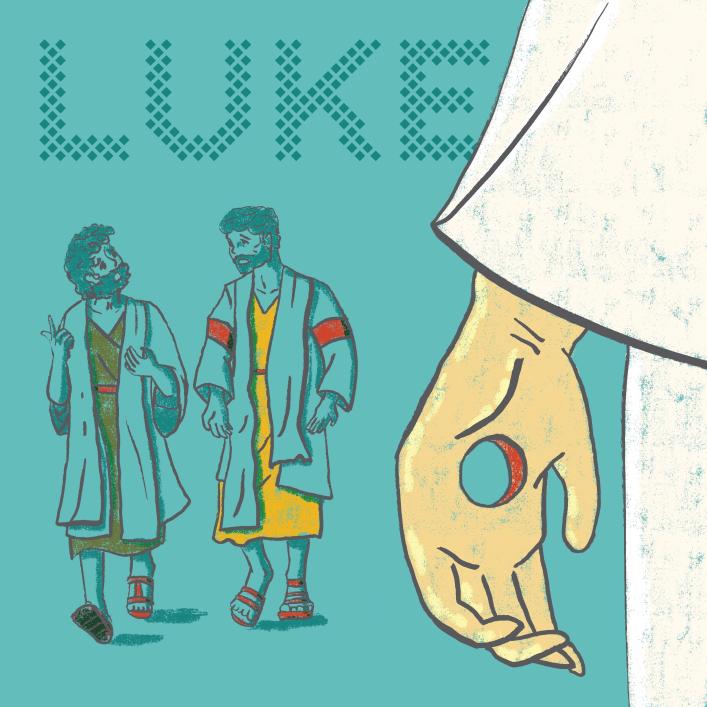
Now, Steve, if you could put that picture of our series back up, the Luke one. This is actually the very scene that's depicted here in our series graphic that Clara did for us. This is the Lord Jesus Christ on the Emmaus Road with these two disciples. And as you can see, Jesus, even though in his resurrection body still bears the marks of his suffering. And it's a it's a such an important moment in the gospel of Luke, because we're told here that Jesus Christ and his suffering and his glory was not just some invention of the New Testament, but rather this had always been and Jesus had always been at the center of God's revelation to the world.
In the law and then on through the prophets and everywhere else in between, Christ the center. Christ the story, his sufferings, and his glory. He is at the center. That's the thinking really behind our new series in the mix. First Sunday of every month, we've got Jesus in Genesis, and then Jesus in Exodus, and Jesus in Leviticus, and Jesus in Numbers, and Jesus in Deuteronomy, all through the law, Christ is there.
And then on into the history books, and through the wisdom literature, and into the songs and the prophets, Christ is there. Luke 24, beginning with Moses and all the prophets, he explained to them what was said in all the scriptures concerning himself. The law and the prophets are about Jesus. And it seems to me that right at the beginning of his gospel, Luke wants us to see that even when Christ is just eight days old. He wants Theophilus, and he wants us to know that Christ is the center of the law and that Christ is the center of the prophets.
That's really how this lovely little story breaks apart. We've got Christ in the temple doing what was required by the law, and then we've got Christ sung over by the prophets. The prophets and the law, the one and the other are about and point to Jesus Christ as indeed all of God's word does. And so we're gonna break up this section just like that. First, we're going to see the way in which the law points us to Christ in Luke two.
Then we're gonna see the way in which the prophets point us to Christ here in Luke two. And then we're gonna ask, what about us? Are we going to listen to their voice? Will we hear the testimony of the law and the prophets this morning as they speak to us about Jesus? So first, Steve, if you wouldn't mind, we have the first heading up.
The law points us to Jesus. So let's look together at verse 21. It's now eight days after the birth. And so we can imagine that for Mary and Joseph, all the energy and the nervousness of childbirth is now beginning to fade. They've come home from the hospital as it were, so to speak.
They've now been discharged, and now the routine is settling in. The feeding and the caring and the washing and the not sleeping, you know, all of those normal things that come with childbirth. They're getting into that routine. And part of that will now be doing what is required of them by the law of God. That's gonna be part of their routine.
And so verse 21, on the eighth day, when it was time to circumcise the child, he was named Jesus. There's the name. There's the name, Jesus. The name in which we gather this morning. The name which is for Christian people, the name above every names.
It means Yahweh saves. The Lord who saves has sent a savior, and you shall call him Yahweh saves. John Newton in one of his famous hymns has the words, how sweet the name of Jesus sounds in a believer's ear. It soothes our sorrows, heals our wounds, and drives away our fears. It does, doesn't it?
How sweet is just the name Jesus in the believer's ear. What power it has to soothe our sorrows and to relieve us of our fears. Jesus. Jesus, the name above every name. And on the eighth day, Luke tells us it was time to circumcise the child.
Now in our culture, in this particular part of the world, this particular scene is not quite as festive as the angels or the shepherds or the visit of the wise men or the manger or any of those things that we normally associate with this time of year. Circumcision is a lot less likely to feature on our Christmas cards than angels and shepherds and for very good reason, I think. And yet, at this particular time, and as you probably know, in the world of the Bible, circumcision was very, very significant. Beginning in Genesis chapter 17, it was a sign of God's promise to his people. It was a way of indicating that God had made a promise to a people, and by faith, they would trust that promise and then receive a sign of that promise.
It was a way of indicating we are part of the promised people. That was the story behind it. And clearly, Mary and Joseph want to identify Jesus with that story. You remember back in Luke chapter one, when Mary made her song, we learned from her song that she loved the old, old story of God on his faithfulness. Remember some of those words about how the Lord had remembered to be merciful to Abraham and his descendants forever just as he promised our ancestors.
She loved the old story, the promise made to Abraham and the faithfulness of God through the generations to all of her ancestors. And now that she's got the firstborn son, the Lord Jesus Christ, she wants to bring him into the story of God and his faithfulness. That's what circumcision about. My son will be in the story of God and his people. Just been reflecting on that this week, how every child is either born or adopted into a story, aren't they?
Every child is born into a story that has been going on long before they arrived. They enter into a family with its own history and with its own traditions and with a life that has been shaped by events that they know nothing about, and they take their place in the story. Now sometimes that is for them a very nice and happy story to be part of, and sometimes it's a very horrible story to be part of, and sometimes it's somewhere in between, but it is unavoidable, isn't it? We all enter the world as the next chapter in a story that has been being told long before we arrived. Now in our particular day, we want to try to kind of buck that trend a little bit and say, no, no, you absolutely do not need to belong to anyone else's story.
You make your own story. You are the story. You write your own chapter. You're the center of it and all that goes with that particular way of thinking. But in Luke chapter two, with the circumcision, we got to understand this is not just a religious formality.
It's a way of Mary and Joseph saying, we belong to a story of promise. And our son Jesus is going to take his place in the story, not just as the next chapter, but as the very essence and main character of this great story that is being told. But there's more even to this circumcision than just the story. We also need to remember that this was a legal requirement. It's not just the romance of the story.
There's something legally required of them here. You can see Luke's emphasis. Have a look in the verse 22. When the time came for the purification rights required by the law of Moses. Verse 23, as it is written in the law of the Lord.
Verse 24, what is said in the law of the Lord. Verse 39, when Joseph and Mary had done everything required by the law of the Lord. You know, you wonder what is behind this repetition? The law of Moses, the law of the Lord. Why so much emphasis?
Because we are meant to understand that from the tender age of eight days, Jesus had not come to abolish the law. He had not come just to do his own thing and to write his own script, but rather as he himself would say, I have come to fulfill the law and all of its perfect requirements. From eight days old, he's obeying, living in accordance with the law of God. And so it turns out that verse 21 is actually really quite significant verse, Because you've got a combination in verse 21 of obedience to the law and Yahweh saves. So what is the connection then between the way in which Yahweh saves and Jesus' obedience to the law?
Well, the New Testament unpacks that for us so clearly, doesn't it? That in order for us to be saved, we need our sins to be taken away, firstly, but we also need to be made righteous in the sight of God. It is not enough for a person just to stand forgiven. They need also to be wrapped up in a perfection, a righteousness of God. And so on the eighth day, they circumcised him.
It may seem like an irrelevant detail to us, and yet it shows us that our Lord Jesus Christ will not only die in our place, but he will live in our place. Not only is he gonna die on a cross under the curse for our law breaking, but he will live perfectly in the sight of God on our behalf. So that when you or I, when any person places their sincere faith in Jesus Christ, we are not only made forgiven, we are made right before God. It's a really important thing, isn't it? The only reason that you or I can be clothed in the righteousness of Jesus Christ is because at eight days old, there was a concern to live that righteous life.
To do all that was required by the law, so that his perfections could be counted to us through faith. That's what I love about this passage. There's no there's no there is no angelic choir in this scene, and there are no Bethlehem fireworks in this scene, and there is nothing that you would put on a Christmas card in this scene. And yet Luke is saying, friends, pay attention in the temple. Pay attention in the temple, because you will learn Christ here as much as you learn him from any angelic announcement.
You will see him and what he is and what he's come to do in these legal matters as much as you will anywhere else. Our salvation is in his law keeping. And in verse 22, it's more of the same. We're we're about a month on now from verse 21, and Luke is gonna just combine various legal things for us in this little paragraph. So we're told that there was a need for purification after childbirth.
Now, if you're familiar with the inner chapters of Leviticus, you might know that already. That was another part of God's law that after childbirth purification was required. And for that cleansing, there would be an offering of a lamb and a dove or a pigeon. You can read about that for yourself in Leviticus 12. It would be a lamb or a dove or a pigeon, or if the mother or the family was particularly poor, they could offer two doves or pigeons.
And so we're just reminded here in this little scene that Jesus Christ entered into poverty. He entered into humiliation. His parents could not afford a lamb, and so they had two doves or pigeons. And then alongside that, there's a connection to Exodus 13, in which the first male child of every mother was to be presented to the Lord. And that was to remember that day in Egypt, where God saw the blood of the lamb over the houses, and he spared the firstborn sons of Israel.
And so what have we got here in this combination of legal requirements? Are they just duties to fulfill? Well, are, but they are also pointing us again to the Lord Jesus Christ. The law points us to Jesus. Mary cannot afford a lamb, but that's okay because she happens to be holding the lamb in her hands.
The firstborn over all creation, who is gonna live and die and offer himself as lamb of God, so that you and I might be cleansed of all our unrighteousness. The cleansing laws point us to the one who cleanses. The firstborn laws point us to the firstborn. The offering of the firstborn points us to Christ who lived and died for us. He is our sin bearer.
He is our law keeper. He is the next chapter in the story and the fullness of the story. The law is saying, look at Christ. Look at Christ here in the temple. And look at his parents.
I mean, from one angle, they are, you know, they are so poor and they are nothing in the sight of the world. I mean, nothing in the sight of the world. So easily overlooked in the world's eyes. And yet from another angle, could we not say that the salvation of the world hinges on their ordinary faithfulness to the law of God? The law, Luke says, points us to Jesus as he will tell us on the road to Emmaus.
Secondly then, let's look now at the way the prophets point us to Jesus. We can have the second heading up, Steve. The prophets point us to Jesus. You ready to meet the prophets? Here we go.
Verse 25. Now there was a man in Jerusalem called Simeon who was righteous and devout. Now we don't actually know how old Simeon is. We assume that he was quite old because he talks about his own departure as if that was something quite close at hand. But in many ways, this was just, I guess, an ordinary day for Simeon.
He gets up and he has his breakfast and he goes out the front door and he walks up the garden path, and he takes the road that he has trodden so many times in his life up towards the temple. And as he turns a corner and rises over a hill, perhaps he sees those glorious white stones, which he has seen so many times in his life. And he sees the sunshine in Jerusalem bouncing off those white stones, And he admires for a moment the beauty of all that adorns that glorious building. And every day, he probably thought to himself on that commute. Maybe today's the day.
Because we're told in verse 26 that at some point, the holy spirit had given him a special revelation. He wasn't a priest, nor was he a high priest, nor does he seem to be anyone of any real significance in the temple, but the holy spirit had told him that he would not die before he saw the Lord's Christ, who is called in verse 25, the consolation of Israel. That's a really beautiful title, isn't it? The consolation of Israel. It has these deep roots in the old testament.
We think of Isaiah who says, comfort. Comfort for my people. Speak tenderly to Jerusalem. Her hard service is over. Her sins are paid for.
Comfort for my people. We'll sometimes say to each other when we're going through difficult times, if we've got something we think is helpful to say, we might use the phrase, well, if it's any consolation to you. And we try then to say something that will console them in their sadness, Jesus Christ is called the consolation to Israel and to all the people of God. The comfort that he provides us with in this sinful and sometimes very weary world is Jesus. It's Jesus.
And yet there are so many other places that we can try to find comfort in our difficulties, we? I think that's something that you and I, we all have in common, that when we're feeling a bit flat, or when we're feeling discouraged or tempted, the one thing that you and I have in common is we go to places for comfort. We look to things to soothe us from the pains of this world. Now sometimes we choose things that only make us sadder, don't we? We think that a quick flash with sin is gonna bring soothing to my weariness and my sadness.
Or sometimes there are certain pains that we feel, and we think, if I can just distract myself for long enough and throw myself headlong into some kind of career or endeavor, which will just take my mind off the things that are painful, it will provide some consolation for a while. I won't have to think about it or face it. I can bury it with distraction. We have that in common as fallen people. We look for soothing in the things of this world.
And wrapped up in this brief title, the consolation of Israel, is all the soothing and comfort that we could ever need. What is the consolation that God provides us with? It is not a a letter explaining exactly why we go through difficult things, and it is not a cheap promise that if you believe in Jesus, your life will get better. The consolation that he provides is one that can be held in your hands and seen with your eyes. It's Christ who comforts us in our sin, gives us peace in our weariness.
Jesus, the consolation of all of God's people. And you can just imagine the workings of providence here in the temple. Mary and Joseph are approaching to do what must be done. And Simeon is approaching as he has done for many years. And then the moment comes where they see each other in the temple.
Wherever they were inside the temple, you can imagine Simeon laying eyes on Mary and Joseph and the infant in their hands. And he in that moment is able to discern by the Holy Spirit that the Lord's Christ is in the house. And what joy fills his heart in verse 28. Simeon took him in his arms, and he praised God, saying, sovereign Lord, as you have promised, you may now dismiss your servant in peace. For my eyes have seen your salvation, which you have prepared in the sight of all nations.
We saw last week, didn't we? Do you remember that the manger is like an emblem of accessibility? It's the symbol, that manger, which means all can come, rich or poor, Jew or Gentile, you can come to the manger. We're told here that Jesus in verse 32 is a light of revelation to the Gentiles. This is Theophilus, you know, you can come.
He's a light for you and the glory of your people, Israel. Isn't that an amazing thing for him to to be saying? That word depart, apparently is quite a gentle word. It can be used of the untying of a ship or the letting down of a tent. You know, when the ship comes to depart, it's just loosened from its moorings and can begin to depart.
So when it's time to finish the camping trip, the tent is let down and it departs. And Simeon is saying something like that here. He's saying, you know, what else is there for me to see now? What else is there for me to see? I don't need to go and see the Great Barrier Reef.
I don't need to climb Everest and see the world from those heights. I don't need to see myself at the top of some corporate ladder. I don't need to see myself as a success in the world's eyes, because in this face, I see the very marrow of life. I see the best thing that life could provide me with, and it's Jesus. And I can depart in peace now because I've seen the best that life could allow me to see.
And we say to him, well, Simeon, you know, just hold on. If you if you can hold on just thirty years more, you'll get to see him walk on water. Don't you wanna hang and see that? Don't depart now. He's just getting going.
And you'll see him feed the 5,000. And you'll see him heal the demoniac. There's just thirty years more. We'll look at your medication. We'll work out a way to keep you...
And you'll see the bet. He says, I don't need to see that. I don't need to see that. I've seen now everything that I need to see. In the face of this infant, I have seen God's salvation.
There is nothing more that life could give me, and I'm ready to untie myself and depart. It's worth remembering, isn't it, as we pray for saints like Anne coming towards the end of life, lived a long life, but we know that she has known the best that life could give. She's she's tasted the marrow and the sweetness. She's seen the Lord's salvation, and she can depart in peace. Verse 33.
The child's father and mother marveled at what was said about him. Then Simeon blessed them and said to Mary, his mother, and this is why he's a prophet. We've seen the law, now the prophet's gonna speak. This child is destined to cause the falling and the rising of many in Israel and to be a sign that will be spoken against, so that the thoughts of many hearts will be revealed. We're gonna revisit that in a moment, but notice these troublesome words, and a sword will pierce your own soul too.
He says, Mary, this child is gonna be a means of blessing to you, but will also be a source of pain and a personal one. And that was true, wasn't it? Not long from this scene, they are gonna have to become refugees in Egypt to save Christ from a murderous Herod. It's a type of sword through her own soul, a sadness that she'll have to bear. And she would grow up to live this boy rejected and misunderstood by many in Israel and betrayed by those who profess to be his best friends.
And even she herself would have confusing times with Jesus, wouldn't she? She wouldn't always be sure what he was up to or what he had come to do. And then you can imagine her right at the end of the life of her firstborn. She would be there at the cross when all his male friends had disappeared. And you can imagine that at the moment that centurion or soldier took up his spear and drove it through the soul and the heart of Jesus, That as the moment it pierced his skin, she felt it go through her own heart and side as well.
A sword will pierce your own soul. If you've got children or maybe you've got nieces and nephews, you will know the way in which pain and sadness felt by them can be felt so sharply by you as well. The sword that pierces them has a way of piercing your own soul as well. And as she's reflecting on that, we're told that another prophet appears. Have a look at verse 36.
There was also a prophet Anna, the daughter of Penuel of the tribe of Asher. She was very old. She had lived with her husband seven years after her marriage, and then was a widow until she was 84. She never left the temple. Now they did apparently have rooms in the temple facilities that people could could stay in.
So maybe she actually never left the temple, or maybe it's just a way of saying she was there a lot. She worshiped night and day fasting and praying, coming up to them at that very moment. So we imagine Simeon holding Jesus, saying things to Mary and Joseph. And at some point during that exchange, Anna has come up. She's seen the hubbub, and she's coming as a prophet.
She wants to say her prophecy and sing her praises. She gathers with this little crowd of the poor and the aging around the child. She gave thanks to God and spoke about the child to all who were looking forward to the redemption of Israel. I love this woman. Depending on how you read it, and you'll notice if you've got a footnote at the bottom of your bible, Anna could be a 105 years old at this point.
If she lived as a widow for eighty four years and was married for seven years, and presumably was a teenager when she got married, she could be something like a 105. And so in terms of physical service in the temple, there was probably much that was behind her. She wasn't probably able anymore to unload the van or to set out the chairs or to pack away at the hub. Those days were probably behind her. But my goodness, Luke wants us to know that she was lively in faith.
And you can imagine how people like the Pharisees might have despised her, just as they did with those shepherds. They looked at this aging woman creeping into the temple again, and wondered whether she was able to give anything anymore, cluttering the place up. Isn't it time to move her out to pasture? But Luke wants us to know that this woman was a mighty prophet of God. And she spoke words of redemption to all who would listen, to all who looked forward like Simeon did to the consolation of Israel.
If anyone was in the temple on any given day, looking forward to the consolation of Israel, the mighty prophet Anna was there to speak to them about words of redemption and about the consolation of Israel. That was her life, and that was her ministry. Isn't that good? It would have been so easy for her to say, the exciting days of God's work are now behind me. My days of serving the Lord with joy are over.
I'm 105. I've had my time of usefulness now. But Luke says her most exciting days came right at the end, and she lived ready to enjoy the next chapter in God's plan. Who knows what she might see at 105? The latest step in the unfolding plan of God's redemption.
She lived with the thought that she might experience the next great thing. It was not all behind her. The best days weren't gone. Something more could come. And it's wonderful, isn't it, in our church to have older saints who have a similar lively faith, and they speak words of redemption to people who will listen.
And they do what they can to encourage the work of God, and they live hopeful that they might still see days where they can be of use in the kingdom of God. How blessed we are to have saints like that among us. That might be something good to discuss with your neighbor afterwards. Which Annas and which Simeon's are we grateful for here at Cornerstone? Because we do have them.
And so we're seeing that Jesus is the center of the law, and we're saying that Jesus is the center of the prophets. They're all pointing us to Jesus. And so after hearing their voice and their testimony, let's put the question to ourselves. Thirdly and lastly, will we listen? Will we listen to the voice of the law and the prophets?
Prophets. Come back with me to verse 34. This child is destined to cause the rise, the falling and the rising of many in Israel and to be a sign that will be spoken against so that the thoughts of many hearts will be revealed. He's saying, Mary, there is going to be no middle ground with this child. And in him, the thoughts of many are gonna be revealed.
It's an amazing sentence. If you want to know what is really in a person, see what they make of Jesus. See what happens when they're confronted with the biblical Jesus, because he more than anything else reveals the thoughts of the heart. We see what is in a person when they have to do business with the Lord Jesus Christ. It is very interesting, isn't it?
How we can sit in meetings like this and we can hear so many things about Jesus, but it's not until we have to personally face him as Lord, as sin bearer, as righteousness, as the one who makes a call and a summons on our lives. It's when we have to face him in that capacity that the thoughts of the heart are really revealed. You see that in Christian life and in Christian ministry. You have folks who come for many years, and they like the idea that Jesus could be the consolation to them and the comfort. And they sit and enjoy many truths about Jesus, but sometimes the time comes where they must actually hear him as Lord, making some kind of call on their lives, and it's not until that point when the word has got to come in that the thought of the heart is really revealed.
I think that's what Luke is saying to Mary here, that the ministry of Jesus is gonna reveal like nothing else can, what is truly within us. And there will be no middle ground destined to cause the falling and the rising. Whether we rise or fall has almost nothing to do with our income or our job or how other people see us, whether we're liked by them or disliked by them, our rise and fall has so little to do with those things. It has to do with Christ. If we will humble ourselves and believe the words that we've sung together, that Christ is all my righteousness, we will rise.
We will rise. We will rise now, and we will rise eternally. But if we will not listen to him, and we will not have him as our sin bearer and our righteousness, then that will be the beginning of our collapse in this life, and that collapse will continue to go on and in for all eternity. The Lord Jesus Christ for every person in this room will be a means of rising and resurrection or total collapse. Destined to be the falling and the rising.
Brothers and sisters, the law and the prophets point us to Jesus, and our destiny hangs on whether or not we will listen to them. Will we take him as our consolation, or will we walk away? We don't do this every single week here at Cornerstone, but I wanted this morning to give you an opportunity, because it might be that there are some here who for the first time have realized that they want to rise with Jesus and not fall. And so on the screen, I'm gonna put up a prayer. There's nothing special particularly about this prayer, but it would be a way of responding for the first time to the Lord Jesus Christ who we've seen in scripture today and saying, want Jesus to be my salvation.
And even if you're a Christian and you've been following the Lord many times, there's absolutely no reason why these words don't apply to us today because we want these truths for ourselves. So I'll give you a moment of quiet. You can read through it, and then I'll say the words together and hand back over to Dean. Let's take a moment of quiet just to reflect on what we've heard this morning. Heavenly father, thank you that Jesus is at the center of your great story of salvation.
He lived the perfect life I could never live and died on the cross for my sins so that I might be forgiven and made righteous in your sight. Lord Jesus, forgive me. Cleanse my heart and be my savior. Help me to walk in your light and rest in your peace. Like Simeon, may I recognize your salvation.
And like Anna, help me to speak of Jesus with joy and share the hope found in him. Amen. Amen.