 What's the Best Thing about a Hip Replacement?
 9 sermons




Genesis chapter 32.
My name is Tom Sweetman. I'm 1 of the pastors here, and it's, lovely to have you with us this morning, we're going to read this whole chapter of scripture, and then we're going to have a think about what it says and the meaning it has for us. And this is a series that we've been looking at in the, book of Genesis. If it's your first time here, and, we've been following along particularly in the in the life of Jacob. So let's turn now to Genesis 32 verse 1.
Jacob also went on his way, and the angels of god met him. When Jacob saw them, he said, this is the camp of god. And so he named that place, Mahanam. Jacob sent messengers ahead of him to his brother Eesau in the land of Sia, the country of Eden. He instructed them, this is what you are to say to my lord Eesau.
Your servant Jacob says, I have been staying with laban and have remained there until now. I have cattle and donkeys, sheep and goats, male and female servants. Now I am sending this message to my lord. That I may find favor in your eyes. When the messengers returned to Jacob, they said, we went to your brother Eesaw, and now he's coming to meet you.
And 400 men are with him. In great fear and distress. Jacob divided the people who were with him into 2 groups and the flocks and the herds and the camels as well. He thought, If he saw comes and attacks 1 group, the group that is left may escape. Then Jacob prayed.
Oh, god of my father Abraham. God of my father, Isaac. Lord. You who said to me, go back to your country and your relatives, and I will make you prosper. I am unworthy of all the kindness and faithfulness you have shown your servant.
I had only my staff when I crossed this Jordan, But now I've become 2 camps. Save me. I pray, from the hand of my brother, Esul. For I am afraid he will come and attack me and also the mothers with their children. But you have said, I will surely make you prosper and will make your descendants like the sand of the sea which cannot be counted.
He spent the night there. And from what he had with him, he selected a gift for his brother Eesaw. 200 female goats and 20 male goats, 200 yews and 20 rams, 30 female camels with their young, 40 cows and 10 bulls, and 20 female donkeys, and 10 male donkeys. He put them in the care of his servants, each herd by itself, and said to his servants, go ahead of me, and keep some space between the herds. He instructed the 1 in the lead when my brother, Eesaw meets you and asks, who do you belong to?
Where are you going and who owns all these animals in front of you, then you are to say they belong to your servant, Jacob. They are a gift sent to my lord Eesaw. And he is coming behind us. He also instructed the second, the third, and all the others who followed the hurts. You are to say the same thing to Eesau when you meet him, and be sure to say your servant Jacob is coming behind us.
For he thought, I will pacify him. With these gifts, I am sending on ahead. Later when I see him, perhaps he will receive me. So Jacob's gifts went on ahead of him, but he himself spent the night in the camp. That night, Jacob got up and took his 2 wives, his 2 female servants and his 11 sons and crossed the Ford of the Jabok.
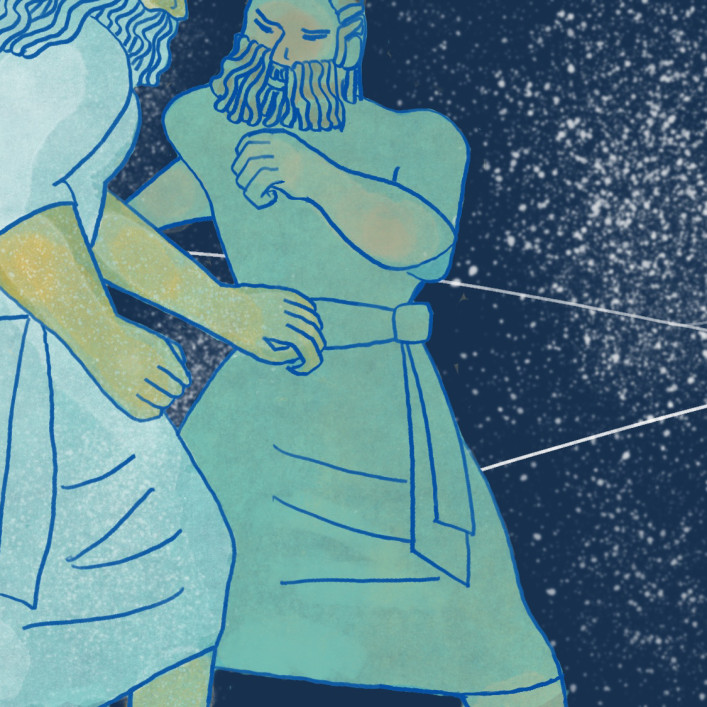
After he had sent them across the stream, he sent over all his possessions, so Jacob was left alone. And a man wrestled with him till daybreak. When the man saw that he could not overpower him, he touched the socket of Jacob's hip so that his hip was wrenched as he wrestled with the man. Then the man said, let me go for it is daybreak, but Jacob replied, I will not let you go until you bless me. The man asked him, what is your name?
Jacob, he answered. Then the man said, your name will no longer be Jacob, but Israel because you have struggled with god and with humans and have overcome. Jacob said, please tell me your name. But he replied, why do you ask my name? And then he blessed him there.
So Jacob called the place Peniel saying, It is because I saw god face to face and yet my life was spared. The sun rose above him as he passed Peniel and he was limping because of his hip. And therefore to this day, the Israelites do not eat the tendon attached to the socket of the hip because the socket of Jacob's hip was touched near the tendon. That's god's word to us this morning. If you're new to this series and you haven't caught up or been following along, this morning, we join Jacob on the eve of his greatest ever trial.
Behind him is an uncle that he doesn't like very much, and he doesn't trust. And in the middle is everything that Jacob owns. To start with it was just a staff, but now look at what the lord has given him. He's got all kinds of hurts and servants, and he's got children, and he's got wives. All have earthly possessions are with him in the middle and untrust with the uncle behind him, laban, and in front of him is now a brother who has every right to hate him.
You see the last time Jacob and Eesaw met, things were pretty tense between them. If you know the story, you'll remember that Jacob had taken advantage of his brother, Eesaw, not once, but twice, had at first tricked him out of his birthright for a bowl of lentil stew, and then a bit later on had tricked him out of his blessing by lying repeatedly to his father at the command of his mother. And when Eesaw discovers all that Jacob has done, he was furious with him. He thought what a slimy brother, I have, and his heart was filled with rage. And you remember what Eesau said those few chapters ago, something to the effect of when the time comes or when the right time comes, I will kill my brother, Jacob.
His mother gets wind of that quickly sends Jacob away, and for the last 20 years, he has been in exile working for his uncle, laban. And so the last time these 2 met, esau had murder in his heart. He wanted to see the blood of Jacob. He wanted him dead for all of his trickery, and now Jacob is about to meet him again. He's on the eve of his greatest trial.
And yet in some ways, what frightens Jacob the most, I would suggest is not actually Esaw. But what he saw represents. Namely, Jacob's guilt and his past and the lies that he's told and the things that he's stolen, and the relationships that ought to have been put right, but weren't. That's what esaw is to Jacob. It's not just esaw the frightening future, but esaw the skeleton in my closet.
If you're, not from the UK and English isn't your first language, you may not know that phrase skeleton in the closet, but it's basically a term for something that we might have in our lives maybe something from the distant past or something from a more recent past that we would rather lock away and not deal with. Something we don't want to get out and talk about. Something we'd rather forget and pretend never happened, and we don't want to deal with it. Well, here is Jacob, and he saw, and all that he saw represents guilt and lies, and the brokenness of the past is now a skeleton resurrected, and it's out of the closet, and it's walking towards him. And he's gotta face his past, and all that he's done in his past.
He's on the eve of his greatest trial. And yet just look at god's first act in this passage. Chapter 32 verses 1 and 2. Jacob also went on his way and the angels of god met him. When Jacob saw them, he said, this is the camp of god.
And so he named that place, Mahane, which means 2 camps, as if to say, Jacob saw his own camp, and he saw god's camp. Verse 1. The angels of God met him. That is such a significant phrase because the only other time that phrase is used in Genesis and in fact the whole Bible, the angels of God, is the last time Jacob saw them. So you remember back in chapter 28, if you've got a hard copy of the Bible or on your phone, you wanna flick back Jacob, Genesis 28 verse 10, we're told Jacob left Bier Sheba and set out for Haron and then verse 12, he had a dream in which he saw a stairway resting on the earth with its top reaching to heaven, and the angels of god were ascending and descending on it.
And what is so significant about that is not so much what he saw, but when he saw it. You see, the first time Jacob saw the angels of God was when he was leaving the promised land and about to begin his time in exile. The next time he sees the angels of God is when he's on the cusp of going home back to the promised land. And so it's as if the lord is saying to him for all the time that you are a stranger and an alien and an exile away from home. I want you to know I am with you.
I've been with you. When you left, you saw angels of God to remind you I would be with you. And now as you return, you see it again. To remind you, Jacob, that not for 1 day of your exile life, have you been left alone? It's 1 of the wonderful things about a camp of god, isn't it?
A camp is a movable portable structure. All you have to do is unpinch it and you can move. Or so it has been with god and Jacob wherever he has been, god has been unpitching and repitching his tent to make sure that he's been with him the whole time. And yet despite that, what I think he's must have been a very powerful encouragement for Jacob on his way to meet Eesaw. You notice Jacob wants to make a plan still.
He still wants to make a plan, and really chapter 32 is actually all about planning. And so we're gonna just divide the chapter into 2. It's like emergency planning, you know, planning for an emergency. You've got this you've got this chapter and it's 2 headings. You've got number 1, Jacob plans to meet Eesaw, and then you've got number 2 god's plan for Jacob.
Number 1, Jacob's plan for esau, number 2, god's plan for Jacob. So let's have a look at that first 1. Jacob's plan for esau. And let me take you first to the middle of the reading because I think this is probably the best part of Jacob's plan. This is the best part of his plan and his prayer.
Verse 9, then Jacob prayed. Oh, god of my father Abraham. God of my father, Isaac. Lord. Now, if you're new to the Bible, whenever you see in the Old Testament, capital l o r d, that tells you that a word has been translated, and the word in that case is the name, the personal name for god, which in the old testament is Yairway.
So whenever you see the capital l o r d, that's Yairway in the original Hebrew, Now why does that matter? It's because Jacob for Jacob, this is the first time he has ever called god by that name. In the past, he has only ever used generic labels for god, like god and small l o r d, this is the first time in his life that he has taken the covenant name, the relational name for god upon his lips. And just as an aside, that is always a sign that someone is growing. When you notice in their prayers that they begin to leave behind general names, like dear god and dear lord, which are perfectly fine to use, but when they start using language more like father, Heavenly father, lord Jesus Christ.
That is actually a sign that they're beginning to understand more of what it means to actually relate to God, not just god up there, but my father. So the old testament covenant name for god is Yahweh. For us in the new testament, it's father. Jacob is beginning to use the relational name for god. That's got to be significant in his life.
Then look what else he says verse 10, and who of us, as Christians here, would not be happy with this kind of prayer. I am unworthy of all the kindness and faithfulness you've shown your servant. Isn't that basically the banner over our lives? I am unworthy of all the kindness and faithfulness that you've shown your servant. I had only my staff when I crossed this Jordan, but now I've become 2 camps.
Save me. I pray. From the hand of my brother, Eesaw, for I am afraid. Now there's an honesty in Jacob, which is pretty encouraging. You see up until now, honesty has not been his mode of operation in the world.
His mode of operation has been not telling the truth, shading the truth, lying. Here he says before his god, I am afraid. I'm afraid. He's honest before the lord. And then look how he finishes that sentence.
I'm afraid he'll come and attack me, and also the mothers with their children. Now a couple of weeks ago, when we spent time looking at Jacob's home life, and exploring his life with his wives and his children, he wasn't particularly worried about them, it seemed. It seemed his approach to family life was more hands off the steering wheel, and let's see where this thing let's see where this thing goes. But now all of a sudden, the mothers and the children really matters to him. Become a big deal for him.
I'm afraid they'll attack me and also my mother's the mothers and the children with me. Verse 12, But you have said, I will surely make you prosper and will make your descendants like the sand of the sea. And again, I think that part of the prayer is a is a model of how to pray. Cause you notice what he does there. He comes before the lord, honestly, and he says I'm afraid of this.
I've got this skeleton in my closet, which I don't wanna deal with because it's physically scary, but it also reminds me of my guilt and sin, and I'm afraid But you have said, and he wrestles himself back from the edge with a promise of God. And isn't that how we are to pray? We pray before God, I'm scared of this, and I don't wanna do it, and I've really mucked up But I know you've said, and you love me, and you've promised me, and I don't have to be afraid, and that's how we pray. We bring our fears to the lord, and then we draw from the well of god's promises. And we preach 1 to ourselves that I am like this, but I don't have to stay like this because of what you've said.
And so I think if you take this prayer at face value, it's very encouraging. The only other possible prayer from Jacob was his vow back in chapter 28. You remember after he'd seen the lord in that vision. He says if you will do this for me, and I will be with you, and I'll vow this and that's a bit like a prayer, but really when you read it, it's more like he's sort of talking to himself. But this is unquestionably a prayer.
And for Jacob, this is a different league of spirituality to what he's known before. And so to my mind, this is a good part of the plan. This is a good part. It's gonna pray. But you notice either side of the prayer is a very practical plan.
And so let's have a look at that. Chapter 32 verse 3 to 7. Jacob sent messengers ahead of him to his brother Eesaw in the land of Sierra, the country of Eden. He instructed them This is what you are to say to my lord, esau. Now notice that because he says it again in verse 5 and again later on.
Now you remember right back at the beginning of this series, we heard a prophecy about these 2 brothers. And the nature of the prophecy was, in this case, the elder shall serve the younger. In other words, Jacob will be lord, and esau will be servant. But now, When faced with Eesaw, Jacob is happy to temporarily reverse that order a little bit. Eesaw, you can be lord.
You my lord Eesaw, you can be lord, and I'm just your humble servant, Jacob. I'm your servant. You lord me servant. Hey, he wants that message clearly conveyed. Your servant Jacob says I've been staying with laban and have remained there till now.
I have cattle and donkeys, sheep and goats, male and female servants, In other words, Esau, I'm not likely to steal from you again because look, what I've got now? I mean, I'm not gonna trick you out of anything because I'm a rich man. I don't need anything anymore. Yeah? Something of that there, I think.
Now I'm sending this message to my lord that I may find favor in your eyes. When the messengers returned to Jacob, they said, well, we went to your brother, Eesaw, and now he's coming to meet you and 400 men are with him, which I think must have been pretty terrifying for Jacob. You can imagine the moment when Jacob's messengers and Jacob reunite. And he's having his cup of tea, and he sees them coming up the drive, and he's out the front door. He's like, how'd it go?
How'd it go? What what did what did he say? What did he say? Well, he didn't say anything? You mean he didn't say anything?
What? Nothing? No. He didn't say anything. Well, did you Alright.
Well, how did he look? What was his expression like? Was he happy? Was he angry? Did anybody holding a sword?
Was he holding a, you know, white flag? I mean, what was what was he holding? What did he look like? I don't know. What do you mean you don't know?
What do you mean you don't know? Well, did he he said nothing? No. So you're you're trying to tell what are you trying to tell me? We're trying to say that Esau, yeah, your brother, yeah, is coming towards you.
Yeah. Silently. Okay. With 400 men. Oh, not what he wanted to hear.
Verse 7 in great fear and distress Jacob divided the people who were with him. And then in verse 13 to 21 after the prayer, it's basically more of the same. So what he does there is he gets everything that he owns and he kind of subdivides it into 5 or 6 different companies, and he sends waves of materialism at Esaw. That's basically how I pictured it as I was reading. It's like being standing in the shallows of the ocean and just wave after wave of generosity is coming towards him.
And so Jacob is taking tens of thousands of pounds of cattle and servants and camels and just throwing it all at esau. And the hope is that after wave 5 or 6, Esoar's rage will have diminished, and he'll be happy. We're actually told that's what Jacob wants. If you look at chapter 32, and verse 20, be sure to say your servant Jacob is coming behind us for he thought. I will pacify him with these gifts I am sending on ahead.
That's basically the plan. And so this is a bit like how in ancient non Christian religion you would have treated a god. The problem with the gods, the false gods of the old testament is you never quite knew where you stood with them. They were in heaven. Were they angry?
You didn't know. Were they happy? You didn't know. Did they say anything to you? Not much.
They might bless your cattle and send the reins 1 year but not the next. And you didn't quite know. And so the way to try to secure their favor was to throw material stuff at them. And by sending material stuff, and maybe by doing weird stuff to ourselves, and showing how good we are. We might be able to mollify this god who could be angry with us, but we're not quite sure because he doesn't say anything.
And so there's something of that here. Esaw is an unknown quantity to Jacob. Doesn't know whether he's happy or sad or angry or murderous or what, and so he's trying to just pacify him with as many gifts as he's got. So that's the plan. There's a prayer, and then either side, there's a plan.
And there's a sense in which I think a lot of this plan actually does make sense. I mean, if you think about it, if if Esore is actually coming with massacre in his mind, then to divide up everything you own into 2 companies, it's not a bad idea. Because if he slaughters 1 lot, at least the other might get wind of it and have a chance to escape. So there's some wisdom in his in his plan there. And again, as we've kind of lamented throughout this series, We don't have a narrator stepping in and telling us that thing Jacob did was good.
That thing he did was dodgy. That thing god loved. That thing god hated. We don't. We just we just it we're just presented with the facts.
But here's the question. For all that is positive about Jacob here, and I think there's a lot, do we see any of the old Jacob lurking in his plans? And I would suggest that we do. Have a look at the repetition with me. We'll just skim through it 6 times.
There's a phrase that comes up here. Verse 16 32 Go ahead of me. Verse 18. Say, they are a gift to my lord Eesaw, and Jacob is coming behind us. Verse 20.
Your servant Jacob is coming behind us. Verse 20, I will pacify him with these gifts I am sending on ahead. Verse 21. So Jacob's gifts went ahead of him. First 24, so Jacob was left.
Alone. 6 times. We have the repeated phrase and idea. That if Jacob must now open up the closet and deal with his skeletons, he will be the very last 1 to do it. He is going to take himself right to the very, very, very back and everything that he owns, including wives and children, are going to go ahead of him.
It's interesting, isn't it? Now, again, there is an argument that what he did there was actually a very courageous thing that the thought was that when esau meets all of these women and children, he'll realize Oh, these are my sisters in law, and these are my nephews and nieces. And why would I want to do any harm to them? This is wonderful. In other words, the best way to secure Eesau's favor was to send a load of new family to him, and that will pacify him.
Could be. Except I think when you take this whole Jacob thing as a whole, his strategy has very often been running to the back. Running away. When he found out that he'd lied to his father and he saw was angry, he hot tailed and ran in the other direction. Last week, when he knew Leben's countenance had changed towards him, we're told that Jacob deceived Leben and stole away from him.
Now you can argue whether he was right or wrong to do that, but the techs wants us to know he he left in a slightly dodgy way. And that's what Jacob has been doing. For most of his life, he's been running to the back. And so I think the safest interpretation of Jacob here and the 1 that fits him best and the 1 that fits me best is that when it comes to facing things we don't wanna face, we're a bit of a messy mixture, aren't we? There are times when we get on our knees, and we pray about it.
And we say lord, I don't wanna face this. And I don't wanna deal with what I've done, but you have promised. And I trust you. And then we say our men. And then we think, how the heck do I get out of this thing?
And we try to put ourselves to the back, and we try to throw other people in front of us, and we wanna avoid it. You know? It's a bit like if we had an elders meeting, and the elders were gathered together, and there was a very difficult pastoral situation that we were facing. And we pray together. Lord, we know what the right thing to do is.
Give us courage to do it. Help us to to walk and deal with this situation. And then instead of sort of me going to do it, I send all of the elders 1 by 1 ahead of me. And each of the elders has gotta have a 1 to 1 meeting with this person first. And then when they've all had a 1 to 1 tried to deal with it, then I'll send my wife and children to meet with this person and see if they can do it.
And if even they can't do it, then maybe at the end, unless it's holiday time, I'll deal with it. Yeah? That's the sort of thing. We can pray, and we know what to do, but then we plan and are planning so often reveals the lack of faith that we don't even trust our own prayers. And I think Jacob is has always been like that, which means it sort of fits for me.
There's flashes of greatness in him, but there's old Jacob in him as well. And so that is Jacob's plan for esau. Let's look now at god's plan for Jacob. And here's the thing to get for this. What god does now in context is very, very surprising.
Because remember, the presenting issue here, and most of the detail in the text is about this, is Jacob and Esoar reconciling. That that's the presenting issue. Jacob has got to meet Esoar. How's it going to go? And yet what does god do to Jacob?
He comes to Jacob, not with a plan of how to make things right with Eesaw. You might expect that when you. God comes, and he gets his stick, and he draws a plan in the sand. And he says, right, Jacob, this is how we're gonna do it. This is what you've gotta do.
This is what you've gotta be careful of. This is how if you phrase it this way and give the camel before the cow, then he'll be really happy because the camel's more precious than the cow. And and that's the way to do it. You'd expect god to come with a strategy for how to do this thing. And yet, what do we find?
We find a god who comes to Jacob, not with a strategy for how to solve his future. But he comes to deal with Jacob. He comes to get his hands on Jacob. Doesn't say anything about his future? Anything about his fears, his sins, his guilt?
He says before we talk about your future, I need to get my hands on you and I need to sort you out. Amazing. Sometimes when it comes to our own problems, what we really want is for them just to be taken away. We look at the things we've gotta face, the things we're scared of, the things we don't wanna deal with, and we think what god ought to do. And the best thing for him to do would be for him just to remove them altogether.
To get rid of that person who's irritating us, to take us out of this situation that we don't like, to save us from a meeting. We don't wanna go into, and we think if he will just remove the scary future, that would be best. And sometimes he does do that. But what we know from this passage is that god also wants to deal with us. He doesn't just wanna remove the future.
He wants to come and see if there's anything in our own hearts that needs sorting out. Let's have a look at it in full. That night, Jacob got up and took his 2 wives and his 2 female servants and his 11 sons and crossed the fort of the Jabok. After he had sent them across the stream, he sent over all his possessions. So Jacob was left alone, and a man wrestled with him till daybreak.
Now you imagine what that must have been like. So here is Jacob, and he's now all alone, and it's the middle of the night. And there are no electric lights, and he has no torch, and he has no torch on his iPhone or anything else. It is dark, but for the light of the stars and the moon, it is dark. All he can hear is the sound of the Jabbok river and whatever other creatures there might be chirping in the night.
And suddenly, from the near horizon out of the inky darkness comes this man emerging from the darkness. Mean, it must have been terrifying. I mean, who is this guy? I mean, it could be Eesaw, couldn't it? It could be Eesaw.
I mean, maybe Eesaw's kind of done the come round from behind, you know, sort of trick. And Eesaw is there. Or it could be an angel of the lord. You know, like the 1 Hag met in Genesis 16 or Abraham encountered in Genesis 18, he would know those stories. Was it Eesaw?
Was it an angel of the lord? This man steps out of the darkness. In order to meet him. Must have been so extraordinary. Jacob was left alone, and a man wrestled with him till daybreak.
When the man saw that he could not overpower him, He touched the socket of Jacob's hip so that his hip was wrenched as he wrestled with the man. Then the man said, let me go for its day break. Jacob replied, I will not let you go. Until you bless me. The man asked him, what is your name?
Jacob he answered, then the man said your name will no longer be Jacob at Israel because you've struggled with god and with humans and have overcome. Please tell me your name. Why'd you ask my name? Then he blessed him there. So Jacob called the place Peniel saying it is because I saw god face to face and yet my life was spared.
The sun rose above him as he passed Peniel, and he was limping. Because of his hip. So much, so much there. You you notice at the start of this scene that it's dark. And at the end of this scene, the sun is beginning to rise.
And I think that's a parable of Jacob's understanding here. At the beginning, it's dark. He doesn't know who this it, who is this? But as time moves on and the physical scene gets lighter, his understanding starts to get lighter. He clearly knows that this is a human.
It would be obvious to him this was a human, but it was also unlike any human he'd ever met before because this human was loaded with supernatural power. With just 1 touch, he could wrench his hip. And as a human, this man would have had a face, but not a face he could fully see because it was still dark. In fact, the text emphasizes the fact that the man wanted to get away before full sunrise so that his face perhaps could not be fully seen. So there is a man with supernatural power, a face that can be seen and yet not quite seen, and here is a man with an authority to change his name and to change his nature and to confer a blessing upon him.
And by the end of this midnight wrestle, as the dawn begins, so his understanding is illuminated. And in verse 30, he realizes, I have seen the face of God. I've seen the face of God and you know in the Bible, there is only 1 name for a god man person. A man who is god, who has the authority to change a name and a nature and to give a blessing. A man who in the middle of the night seems to be losing, but in the point he looks weakest, he's actually preparing to win the greatest victory of all.
It's none other than the lord Jesus Christ. That is who Jacob meets. That is who emerges from the darkness. Before god the sun, bound himself to a human nature forever at Christmas time. He took the form of a man to meet with and change Jacob.
This here is Jesus before there was Jesus. Coming to meet Jacob. And just to fold all of that back into the story, look at what this meets Jacob. Verse 27 to 28. The man asked him what is your name?
Jacob, he answered. Then the man said your name will no longer be Jacob, but Israel because you have struggled with god and with humans and have overcome. You see, up until now, Jacob's life has been a Jacob life. You know, his name means to grasp, and that's how he's gone through life as a Jacob He's been trying to take things which don't belong to him. He's been trying to lay his hands on things he hasn't been given.
He has been a graspa, and a stealer, and a schema. Jacob has lived a Jacob life. But now because of Jesus, his life will be defined not by what he can grab off others, but by the god who grabbed hold of him. He will now be not the grabber, but 1 who was grabbed. By Jesus, and was changed by Jesus.
Or verse 24. Again, look at how the story evolves. Verse 24. Jacob wrestled with him at the start. But in verse 26, it's simply I will not let you go.
He changes from a wrestler to a holder on. And to my mind, that represents a fundamental change of nature. You see a wrestler is 1 who is trying to do things in their own strength. A wrestler I mean, if you saw, I don't know, boxing last night, you know, a boxer or a wrestler, they get into the ring, confident in their own strength. They've done the training.
They've got the muscles. They've learnt the armbar and the rear naked choke, and they they can trust themselves to ret they've got a chance, but a holder on. Is someone who knows they've got no charts in themselves, and they simply need to hold on. It's a bit like what you might do if you were drought drowning and a life ring was thrown to you. You wouldn't try to sort of wrestle the life ring down and prove you didn't need it, you would hold on to it with everything you had saying save me bless me.
He's changed from a wrestler to a holder on. And then in verse 31, the sun rose above him as he passed Penel. Now you remember back in Bethlehem, the sun was setting on him. Here, the sun rises upon him. Says if as he leaves this scene, he does so as a new man, a man who's come out of the dark and into the sunshine, and he was limping because of his hip.
That was an extraordinary thing that is. Here is Jacob, and you notice his whole approach to life has now changed. He's now not going to run-in the wrong direction. He's gonna limp in the right direction. Here is a man who has physically never been weaker.
But spiritually, he's never been stronger. He can no longer run. He's physically disabled, but spiritually, he's met Jesus and he's holding on to Jesus. And so spiritually, he's never been stronger. And then you have that bizarre scene there, don't you?
Verse 29, tell me your name. Why'd you ask my name? Then he blessed him there. You wonder why doesn't Jesus give his name? And it's because sometimes in the bible, there are contexts in which to know somebody else's name is to imply that you are an equal with them or even have authority over them.
So you think about the Garden of Eden with Adam and Eve, 1 of the tasks that they were given was to name the animals, and that was an exercise in authority. It was to say there is a creation order. We know your name, and then we can speak over you. It's always why I find it a bit weird in schools when some schools allow the children to use the teacher's first name. Yeah.
It seems always seems weird to me, you know, that you can, instead of mister Johnson, you call him James. You know, James, can we go for our lunch now? And James, you can, you know, there's there are times when to not use a name is good. It sort of implies a healthy authority. Maybe that's what's going on here.
You know, god is saying, look, I have revealed myself to you, Jacob, but I'm still god to you, Jacob. I'm still god to you. You're not over me. We're not equals. I'm god, and you need me.
You need me and you better cling to me. And so do you see on the eve of his greatest trial ever? God comes to Jacob, not with a plan for esau or with a strategy for esau, but he comes for Jacob. He comes to change Jacob, not his future, but the man who needs to walk into his future. That's who he comes to change.
And so at this point, I think Jacob re I mean, he's not gonna be perfect from now on. He's not gonna be perfect, but I think at this point, he has finally learned the lesson. Which Paul articulated so well in 2 Corinthians 12 that when I am weak, then I am strong. When I am weak, then I am strong. Jacob's plan for esau was unlike god's plan for Jacob.
Lastly, what's god's plan for you and his plan for me? Seems to me that this passage is about us, and there's a lot about human nature in this passage, but it is also about the nature of god. And what we see here is that the god of the Bible can never be discovered or known by human strength. You see, if we go through life, thinking that we've got the strength to do it, and that we're basically quite good people and can manage ourselves. And we've got enough training and experience and money to handle just about anything that comes to us in our future.
If we go through life in our own strength and try to bolt god on to that way of living, then whatever god we're trying to bolt on is not the god of the Bible. Because the god of the Bible is not known in human strength. You don't find him in human strength. You find the god of the Bible in the weakest places imaginable. You find him in a stable where the almighty god of heaven has become 1 who can be held between elbow and fingertip.
The span of a forearm. You can hold. It's incredible strength in the weakest position you might imagine. Or you find him in gethsemane. Where like Jacob, in the dark, he's wrestling.
And he's wrestling because he wants to cling hold of his father and the will of his father, and he wants to triumph through the darkness. And as he sweats, great drops of sweat that are like blood, he's wrestling there. He's wrestling to do the will of god in the right way. He looks pretty weak. I mean, where's his army?
He even says to his disciples, put your swords away. How weak does he look? And yet he's winning the greatest victory of all. And again, you see him on a cross. That's where you really meet him.
In the cross, where like Jacob, his bones were not broken, but they were put out of joint. As he died, to bear the self sufficiency and the pride that has marked our lives. And in what looked like the weakest moment imaginable, he was winning the most awesome victory. A display of strength in the darkness, like we've never seen. We do not find god in human weakness in in in strength rather.
We find him in weakness. And so it might be today that for the very first time you want to say I am fed up of wrestling and I wanna start holding on. I'm fed up of trying to bolt god onto my life, but basically doing it my way. And I want god to put my hip out of joint. I want to know him.
To be weak that I may be made strong, and I wanna come to Christ. Because if you do, if you feel heaven calling you in that direction today, then look at the sort of welcome you can expect. It won't be on the screen. I'm afraid, but please turn if you can to chapter 33 verse 4. Here's the climax of the 20 year story.
The story loop is about to close. How is Eesaw going to receive Jacob. Eesaw ran to meet Jacob and embraced him. He threw his arms around his neck and kissed him. And they wept.
If you're familiar with Luke chapter 15, you might see something there in how the father receives the protocol. It's the same words. Runs towards arms round, kisses, weeps, what a beautiful moment in the Jacob and Eesaw story, but better because it pictures how Christ receives us as we come to him. He puts his arm around us, weeps over us, and rejoices when we come home, when we surrender our weakness and come to be made strong in him. If you're not a Christian, maybe this morning's the time to give up wrestling, and start holding on to Jesus.
And if you are a Christian, this isn't, you know, this passage is not just a moral lesson on on, you know, prayer or how to face your future, but I do think there are times when we when as Christian people, we ought to just get alone with god. We ought to get alone with god, and we ought to say, I will not let you go until you bless me. And I don't wanna face this thing, and I don't like that person I have to deal with. And that guilt in the past, I would rather leave it there, and I don't wanna give that apology that I've been withholding. I don't wanna do it.
But if there is anything in me that needs changing, If there's anything in me that needs dealing with, will you come and put it out of joint and fix me again? You sometimes we're not gonna be able to live in the sunshine of god's will, if we won't get alone with god sometimes, and say, change my future if you can, but change me. Change me. Change how I think and feel about this that I may walk with a limp maybe but be more powerful than I've ever been because I'm trusting you. Have we done that?
When I'm weak? Then I'm strong. Jacob's plan for esau, bit of a mix. God's plan for Jacob so needed. God's plan for you and me.
Well, I hope you've sensed the Lord speaking to you in some way about that. This morning. Let's bow our heads and pray. Father, we understand from this passage that the the things that threaten us most. Are not things in our past or things we'll have to face in our future, but our own self sufficiency.
Our own self sufficiency is our greatest danger. And we thank you that When you met Jacob on this night, you showed him that and you dealt with that. You made him weak that he might be strong by trusting in the lord Jesus. And we pray please that where that needs to happen for each of us, that you would come and do it. We're sorry that our old natures so resist humility.
We don't want to be broken. We don't want to be clinging on. We want to be wrestling. We want people to look upon us and think there's a strong man or woman wrestling their way through life. We are allergic to anything that makes us look weak.
And yet how could it be when the god of heaven became so utterly weak for us? And so help us please, where this needs to happen for our lives, help us. Give us strength, give us grace, and thank you that you are always ready to run to us, to weep over us, to throw your arms around us, and to kiss us. What amazing grace for sinners. Thank you in Jesus' name.