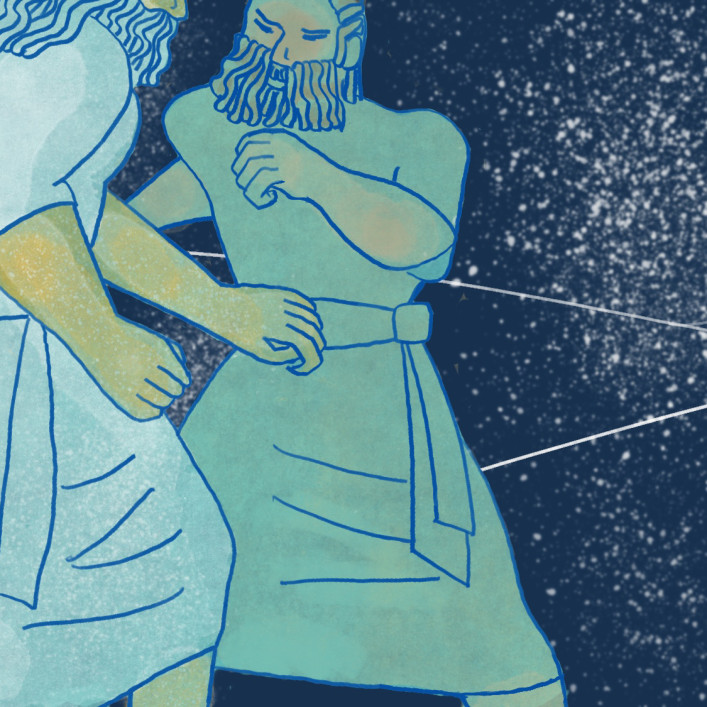
 The Ghosts of Genesis and the War of the Worlds
 9 sermons




This morning's reading is from the book of Genesis and chapter 25, and we are starting at verse 19.
Genesis 25 verse 19. This is the account of the family line of Abraham's son, Isaac. Abraham became the father of Isaac and Isaac was 40 years old when he married Rebecca, daughter of Bethwell, the Arab man from Padan Arab, and sister of Laban the Arab man. Isaac prayed to the lord on behalf of his wife because she was childless. The lord answered his prayer and his wife, Rebecca became pregnant.
The babies jostled each other within her. And she said, Why is this happening to me? So she went to inquire of the lord. The lord said to her, 2 nations are in your room and 2 peoples from within you will be separated. 1 people will be stronger than the other, and the elder will serve the younger.
When the time came for her to give birth, there were twin boys in her womb. The first to come out was red, and his whole body was like a hairy garment, so they named him Eso. After this, his brother came out with his hand grasping Esoil's heel. So he was named Jacob. Isaac was 60 years old when Rebecca gave birth to them.
The boys grew up and Eesaw became a skilful hunter, a man of the open country, while Jacob was content to stay at home among the tents. Isaac, who has a taste for Wilde's game, loved Eesaw, but Rebecca loved Jacob. Once when Jacob was cooking some stew, Eesaw came in from the open country, famished. He said to Jacob, quick. Let me have some of that red stew.
I'm famished. That is why he was also called edom. Jacob replied, first, sell me your birthright. Look, I'm about to die, esau said. What good is the birthright to me?
But Jacob said swear to me first, so he swore an oath to him, selling his birthright to Jacob. And Jacob gave e source and bread and some lentil stew. He ate and drank and then got up and left. So Isor despised his birthright. Thank you very much, Allison, and, good morning, everybody.
And, very warm welcome to, Cornerstone Church this morning and a particular warm welcome if you are visitor us here for the first time. If you don't know me, my name is Tom, and I am still only 1 of the pastors here. Just 1, 1 of the fantastic team of pastors and elders, and, it's a joy to have you here. We are actually beginning a new series in the life of Jacob. So we're gonna be in the book of Genesis, but we're going to be focusing almost exclusively on this man Jacob and his and his life.
And I'm really excited about this this series. I can't actually remember a time when we just focused in our preaching on a particular character. We tend normally to work through books of the bible. We occasionally take on some themes. But just for these next few weeks, at least up to and perhaps into a little bit summer, we're going to be focusing on this man Jacob, who is a, who is a fascinating character.
And this morning, I want us to begin our adventures into his life, not with his birth. We will come to that. We've just read it. But I want you to imagine, first of all, that we are walking through an old cemetery. And the wind is quiet.
And as you're walking through the cemetery, there are leaves blowing across the different paths. And then in a moment, you see a headstone. Just 1 simple plain headstone in the cemetery. And you go up to it and you kneel down, and with your hands, you brush away some of the leaves and the pollen that have accumulated on the stone. And beneath your hand is just a single sentence on this headstone, and it's from hosea chapter 12 verse 3.
Here lies Jacob. In the womb, he grasped his brother's heel as a man He struggled with god. Here lies Jacob. In the womb, he grasped his brother's heel. As a man, he struggled.
With God. If you've ever had to speak at a funeral service, you will know how difficult it can be in just a few minutes to speak about a loved 1. You've got an opportunity, 3, 4, 5 minutes sometimes. And in those few minutes, you've gotta convey all that that person meant to you. How can you do that?
How can you possibly summarize all that, a son or a daughter or a brother or an aunt or a friend or a father or a mother? How can you summarize all those years of shared experiences? And thoughts and emotions and give the people in the room an impression of that person who mattered so much to you in social to time. It's very hard, isn't it? Have you ever had to do that?
And yet I think in this 1 sentence from Jose, just 1 sentence, the whole life of Jacob is near perfectly covered. In the womb, he grasped his brother's heel as a man, He struggled with God. And if you wanted even less, if you wanted to boil that down even further, you could just keep the 2 verbs. He grasped. He struggled.
He grasped. He struggled. That word struggled in hosea 12 is quite rare in scripture. It's only used twice in the old testament once there in hosea, and once in Genesis 32, And we're gonna come to that chapter in a few weeks time. But if it's familiar to you, you'll know that is the story where the angel of the lord and Jacob have a 1 on 1 all night MMA, you know, wrestling match, And at the break of day, just as the sun comes up, the angel of the lord says to Jacob, your name will no longer be Jacob, but Israel.
Because you have struggled with god and with men and have overcome. No longer would his name be Jacob, but Israel because you have struggled and have overcome. It's an amazing moment that. Very significant for old testament history because from that point on, the people of god are going to be known by a name which means a people who struggle and who overcome. That will be the name for all of god's people.
They are those who struggle and who overcome. And not just in the old testament, in the new testament. You turn to Galatians chapter 6 And when Paul is talking about the new creation people of god, the church, he describes them as the Israel of god. That is 1 name for the church, the Israel of god. Has nothing to do with politics, and it has nothing to do with land.
It has to do with the life of faith that the people of god across old testament and new are a people who struggle with god. They struggle with their own sin, and they struggle with their temptations, and they struggle with the valleys of darkness. And liked Jacob, sometimes they struggle with deception. And they wanna run away, and they wanna hide, and they wanna deceive, we are a people who struggle. And yet by faith and the mercy of Christ, we are a people who overcome.
Don't you recognize that testimony and that story in your own life, I am a person who struggles with god, but by the mercy of Christ, I overcome. Gordon Wenham, who's an old testament, scholar and commentator who actually went to be with the lord, just in this last week, wrote a terrific commentary on the book of Genesis, and here's how he describes Jacob and the, the life of the patriarchs. God chooses the patriarchs, not because they are particularly lovable characters, but because of his declared intention that in them, all the families of the earth should find blessing. And so the patriarchs emerged from scripture, not as Lily White Heroes. But as real men of flesh and blood, red in tooth and claw, and with them and their failings, everyone can identify.
Over the next few weeks, we are not going to find any clear hero in Jacob's story, except the lord who is patient with struggles and who enables them to overcome. And that is 1 reason why I personally, and I think many identify so quickly with this dysfunctional man and his dysfunctional family. Because if there is grace, and the possibility of overcoming for even ones such as him, then there's grace for people such as us with all our failings and with all our struggles. So as we begin our time with that series introduction, Let's pray together. Father in heaven, we're grateful for an opportunity to begin this new series looking at the life of Jacob, and we pray that as we look at his life, You would speak please to every single 1 of us here, both today and throughout this series.
And we ask you in Jesus's name. Amen. The headline over his life in healized Jacob in the womb he grasped his brother's heel as a man he struggled with god. Did you notice how that struggle or how how his life of struggle begins even before he's born Even before he's born, there is struggle in his family. And that's actually where our reading starts.
Before we get to his life, we get to his pre birth struggles. And so today, there are just 2 main headings, and they all have to do with the life before Jacob is actually born. So next week, we're gonna actually look at Jacob's birth But in order to understand his life, we need to see what Moses recorded for us in the months and years beforehand. And this is the first heading this morning. The struggle before birth.
The struggle before birth. According to verse 20, Isaac was 40 years old when he married Rebecca. Age 40, he gets married to Rebecca. But look at verse 26, Isaac was 60 years old when Rebecca gave birth to those boys. So those are the numbers married at 40, Kids's at 60.
Married at 40. Kids at 60. And that we pick up from the story was not a deliberate choice. On Isaac and Rebecca's part. In verse 21, we get a summary of 2 decades.
She was childless. Before Jacob even sees the light of day, mom and dad have had 20 years of struggle. They've been living inside this cycle for 2 decades of month by month, hope, and despair, and hope, and despair. And hope maybe this month, and despair. 20 years, before he's even born, there has been struggle in his family.
And if you know the story of Genesis, if you've read it before, you'll recognize that struggle. Sarah, the wife of Abraham, and the mother of Isaac, was barren for 25 years. 25 years. Abraham and Sarah, Jacob's own wife, later down the track. In Genesis chapter 29 verse 31, we're told this, perhaps this will appear on the screen.
When the Lord saw that Leah was not loved, he enabled her to conceive, but Rachel remained childless. You see that? This is like a ghost that haunts the families of Genesis. Jacob's grandmother and his mother and his own wife lived with the month by month by month disappointment of she was childless, and she remained childless. Now our focus over the next few months is mainly gonna be on Jacob, but I I do want us to pause on this for a minute because this is the world that Jacob enters into.
It's worth thinking about that, isn't it? In in order to actually understand a person, we need to understand their contact, context, and the world in which they arrive. It's funny sometimes with their kids, isn't it? You know, they they're kind of looking at photo albums of mom and dad, and they're amazed that you even existed before them. It it's like mom and dad had a life, you know, before I even would really no.
They came into being when I came into being. You know, they can't sometimes imagine that there was a wrestler and a context and a struggle and a living before they came to live. And so it is with Jacob. We won't understand his story of struggle if we don't look at the context into which he was born. And although the narrative moves quite quickly away from she was childless, there are at least 4 helps I can see from this story for this type of struggle.
1 commentator I read observed, barrenness runs in the family is only an oxymoron when god is not at work. Baronness runs in the family. He's only an oxymoron when god is not at work. Baronness runs in the family makes no sense. Makes absolutely no sense.
How can barrenness run-in the family? And yet that is what happens in this story as if to say to us. This whole family is humanly impossible. This is an impossible family. Humanly speaking, these children and these generations should never have come to be.
And therefore, when it did happen, every child was a miracle child. For Sarah to have Isaac required a miracle. For Rebecca to have Jacob and Eesaw required a miracle. For Rachel to go on and have her children required a miracle. And spiritually speaking, that is the story of the church, isn't it?
Every new generation of believers requires a miracle of god. I mean, you think what has gotta be overcome before a new generation of believers can emerge, the barrenness of the human heart by nature, and its natural fruitlessness that by nature, we do not give birth to love for god and faith in Christ. We are dry and barren by nature. That's what we are. And therefore, When that is overcome and faith is given and Christ is seen and the fruit of the spirit emerges from us, that is a miracle story.
It's a miracle story. And that is why we have to keep praying for our Sunday school children. Because when they go out every week, we don't just process them into Christianity, the Christian Factory, and they get on the belt and get processed. We need it to be a miracle workshop in there. Every new generation requires overcoming of spiritual barrenness.
You don't get miracle children without miracle god. And so we have to pray that the lord would bring new generations. They only come by miracles. That's 1 thing that we see from this story. Secondly, I want us to reflect on the way in which disappointment and grace.
Run together in the Christian life. Some of you here won't have to try very hard to imagine a life like this. 20 years. Of month after month after month. Negative test.
After negative test. After negative test. After negative test. And then maybe sometimes it it finally happens. And then for some reason, it then ends suddenly and tragically.
In a way that you didn't expect. And that is both very painful and can be very confusing. I mean, you imagine, I don't think this is a stretch. But you imagine a conversation like this between Isaac and Rebecca. Hold on.
I thought we'd been promised children. Didn't god say that to your father Abraham and to us? As many as stars in the sky, he said. As many as the sand on the sea shore. That was the language he used.
And so what have we done something wrong? Am I being punished for something? Have I been rejected from god's line? Have I misunderstood something I was supposed to understand? We don't have that kind of conversation recorded, but wouldn't those be the natural questions of real faith in real difficulty?
And so what is the answer to them? Well, as you can see in the chapter, there is no easy explanation offered. And there are some things which in this life remain a little bit hidden to us. But we know are safe in the hands of a god who loves us. And yet at the very least, we can say that to experience sorrow of this kind does not mean that you are outside of God's favor and his love and his choice.
We cannot say why they had to spend 20 years from 40 through 60. 20 years with this month by month hope and despair, but we can say that in those 20 years, they were not for 1 second separated from the love and the favor and the care of god. Now I know that with all of these women, this part of their story did end with a child. And for others in this room, that story may never reach the same conclusion. And yet whatever the lord has for each of us, let us never think.
That disappointments of this nature are a sign of our own personal failure or our own personal misunderstanding or our own rejection for the hands of god. In those 20 years, I'm sure they must have wrestled with questions like that. They must have the human of the all, but never had they fallen. Outside of god's loving purpose. And if you are a follower of Jesus Christ today, neither have you and neither will you?
Now I know there's things there that you may want to talk about afterwards, and I'd be very happy to talk with you or to introduce you to an elder or an elder's wife, and all of them would be happy to talk to you about anything there. Third observation. Even if this struggle is not overcome in the body, it is overcoming the church. Just look at what Paul does with this part of the story in Galatians for. This is a remarkable bit of pastoring from the apostle Paul.
Look how he takes up this theme. Galatians 4, 26 to 28. But the Jerusalem that is above is free and she is our mother. For it is written quoting Isaiah, be glad, barren woman. You who never bore a child.
Shout for joy and cry aloud. You who were never in labor. Because more are the children of the desolate woman than of her who has a husband. Now you brothers and sisters like Isaac are children of the promise. Now in context, he's dealing with some pretty big stuff there.
He's dealing with old covenant and new covenant. He's dealing with flesh and spirit. He's dealing with law and gospel. And he's using Genesis narratives to illustrate all of those different points. But then in verse 27, he quotes Isaiah 54 and says about the church.
She's talking about the church here. Rejoice, oh, Baron woman. Now how is she supposed to do that? That doesn't sound like a very good bit of counseling, does it? Regi so barren woman.
Regi how's she meant to do that? Well, because that's exactly his point, he says in the church, don't you see, There is no such thing as a desolate family. There are only children who get adopted into the family of gods who are then turned into aunts and uncles and brothers and sisters and mothers and fathers who then have a hand in raising next generation children of the promise. They become parents. There is no such thing as a desolate person because everyone here is involved in child rearing of the most significant kind of an eternal kind.
I mean, see what he does here. It's like Paul is looking at the church and saying, whoa. Look at that. Here are children where I thought there would be none. I didn't think children were gonna be part of my story, but now I see that they are.
In verse 27, this is a remarkable word, praise. More other children of those women. More other children of church women than of any who have a husband? What is he saying? He's saying that moms and dads in church have more children than anyone else.
Because they are involved in raising children of god for the family of god, which is a forever family. And brothers and sisters How thankful we are for the individuals and the couples in this church who do exactly that role for us week after week after week more are the children of those families than of any who had a husband. And so you see this struggle while not promised to be overcome in the body. Is overcoming the church. Fourth observation under this first point.
Persevering prayer is always a good idea. Persevering prayer is always a good idea. Look back at Genesis 25 21. Isaac prayed to the lord on behalf of his wife because she was childless, the lord answered his prayer, and his wife Rebecca became pregnant. Now that does make it all look very instant, isn't it?
You know, as if Isaac suddenly thought after 19 years and 3 months. Do you know what? I haven't tried? I haven't prayed about it. You know?
And then he says a quick prayer 9 months later, positive test, and there's the if only he'd prayed, if only he'd prayed, then it would have happened sooner. It can read a bit like that, and I suppose it's possible, but I think it's unlikely. I think the more likely explanation given the sort of overall struggle context is that for 20 years, Isaac had been praying for his wife and his family for 20 years. Some of you would have been praying for family members and friends and neighbors for 20 years. That's a long time.
That's a that's a long type of prayer struggle, and I'm sure the Lord has taught you many lessons in those 20 years. And do you see how not a waste of time that is? Now again, we gotta remember that God does not promise to answer all of his children's prayers in the same way. But verse 21 is a good side encouragement. I think particularly to men and particularly to husbands, to meet the struggles in their lives.
With persevering prayer. Here's how, Gordon Wennam puts that. See if we can jump back in here. Throughout Genesis, Isa appears as a rather passive figure, liable to be imposed on by his father, his wife, his children, and foreigners. But here, for the first time, he's presented as taking an initiative.
By interceding for his wife. Brothers god has given us all kinds of personalities. Some of us men are forceful and loud and straight to the front of the battle and fixie type men, fixie type men. Others are much more passive. They don't wanna solve a problem.
They wanna run from a problem. They wanna keep quiet, and they wanna hide under the duvet for weeks when things go wrong. And because all men are sinners, both of those tend towards prayerlessness. Being loud and fixy can be done without god. Just be loud and fixy.
And you can do it without god. Running and hiding under the duvet for weeks can be done without god. That can be done without God. And so do you see by nature interceding for our wives and our church and our disappointments, and our struggles is not our first move. But when Moses wrote the book of Genesis, he clearly thought that that was Isaac's best move.
And so men, and I'm talking to myself as much as anyone else. Do we meet our family struggles? And our work struggles and our ministry struggles? Do we meet the struggles? Perhaps that our wives, is that how we meet the struggles our wives have?
By interceding, persevering, prayer. Persevering prayer is always a good idea. It's the fourth observation. So all of that was basically taken from verse 21. She was childless.
That was all of that was about that, basically. But what it tells us is that to begin Jacob's story is to step inside a real struggle. Do you see that? To begin Jacob's story is to step inside a real struggle. Second point, and it will be much shorter.
The struggle in the womb. The struggle before birth, setting number 1, the struggle in the womb, heading them to. Verse 21, Isaac prayed to the lord on behalf of his wife because she was childless. The lord answered his prayer and his wife Rebecca became pregnant. The babies jostled each other within her.
And she said, why is this happening to me? Now it's not clear exactly what she means by that question. It could either be, why is this happening to me as in what's changed? I thought this wasn't gonna be part of my story. Has someone done something?
Has someone said something? Why is this happening to me now when I thought it never would? It could be 1 way of interpreting the question. The ESV, a different translation of the Bible has it. If it is thus, why is this happening to me?
If it is thus referring to the the jostling, the violent jostling, if it is like this, why is this happening to me? In other words, if there is fighting in my womb, is that some kind of bad omen? Have I now not only not been blessed, but been cursed? What have I done what have I done wrong? Why is this jostling bad omen thing happening to me?
Or another way of translating the question could be, if it's like this, why am I here? In other words, given how upsetting this pregnancy is, would it be better if I didn't survive it? Some desperate. Prayer, isn't it? If it is like this, why am I here?
And to be clear, I don't know what was happening inside her womb, but the the word for jostled in the old testament is normally translated either smash crack into pieces, or in judges chapter 9, it's actually used of the crushing of a skull, a literal crushing of a skull. That is the word being used. So as you read the word jostled, Please don't imagine 2 brothers gently floating past 1 another in the womb sort of competing for first place. What you ought to imagine really is an MMA ring with arm bars and head kicks and choke slams and tap outs and reenacted chokes and those kind of things. That's what's going on here.
Is it there's there's some kind of violence going on in her womb here. 1 writer says, behold how good and pleasant it is when brothers dwell in unity. But to Jacob and Eesaw, any room is too small when they are together. Not uncommon for siblings, I suppose, but This is this is somehow up a notch. And so, however, we translate Rebecca's question, it's as if the it's as if she's saying the sorrow of not getting pregnant has now been replaced by the sorrow of this pregnancy.
Would it be better for it never to have happened? You can imagine, can't you? 20 years of hope and despair? Couldn't it just be normal? Couldn't it just be normal after 20 years?
And now I've got some kind of war of the worlds taking place inside me. Maybe it would have been better if it hadn't happened. And so in verse 22, she goes to inquire of the lord. And again, we're not sure what that involved. It could be that she went to a profit of some some description who may have been around at the time.
It could be that she sought an answer from god in a dream or a vision or something like that. We're not told much about the inquiry, but we are told about the content of the Lord's response. And that's what it moves on to there. In verse 23, these famous words. The lord said to her, 2 nations are in your womb, and 2 peoples from within you will be separated.
1 people will be stronger than the other. And the older will serve the younger. 1 ghost which haunts the families of Genesis is barrenness. The other ghost that seems to haunt the families of Genesis is sibling rivalry. Think about Kain and Abel, Isaac and ishmael, Jacob and his brothers, that whole story hinges on sibling rivalry.
These kind of generational struggles. I don't know if you've just ever thought about that anecdotally, whether you've ever looked at your parents or your grandparents. And particularly as you get older, you kind of think The same kinds of problems they seem to have. I I know I notice. You know, the struggles that they had, I I see them in my own life.
I thought when I was younger that I'd transcended that kind of thing, but I now see there's some kind of generational difficulty that seems in the lord's providence to come down, come down the line, come down the line, come down the line. Why is this happening to me? That's what she says in verse 22. And god responds by saying 2 nations, 2 peoples, and between them, conflict. And again, when you follow the whole Bible story, it will pick this up in future weeks.
You see that that prophecy in Genesis 25 is not just about biology, it's about theology, and it's about the destiny of the church. There will always be a tension between children of promise, and children of this world. Until the lord Jesus Christ returns and ends that struggle, there will always exist a conflict between the thinking and the world views of the people of Christ and the people of the world. There is a kind of conflict that we are destined to. Until price returns.
But let's finish on this because we'll spend more time on that as I say in future weeks. Let's let's finish on this with this surprising word in verse 23. The Lord said to her 2 nations are in your womb. Now in some ways, they that may not be the surprising element because they had been promised nations of people to come from them. So that may not be the precious bit of information.
And 2 peoples from within you will be separated. Again, she would have known, Kayne and Abel isaac and ishmael may not have been the most surprising part of that prophecy. 1 people will be stronger than the other. And the older will serve the younger. Now that line there is really, really significant.
The older will serve the younger. Because at this particular time, it was just not the custom. So in normal circumstances, the younger brother is under the elder brother. And I'm sure all elder brothers have reminded their younger brothers of such an order in their own life. Yeah.
The younger brother is under the elder brother, and in this culture, it was the firstborn male who got the special privileges. And next week, that's gonna become a huge thing when it comes to this whole idea of inheritance and birthright. Because what would have happened at this time is if a father and a a a mother had 2 children, they would have divided the inheritance into 3. The older would have got 2 thirds and the younger would have got 1 third. So divide it so the more children you have, the less you get, but the older gets that sort of double portion.
So that was the that was the culture and how these things worked at the time. But here is the surprising twist on the normal In this case, the older will serve the younger, which is quite amazing when you remember that these are twins. And so, actually, the time difference between the older and the younger is gonna be a matter of seconds, you know, not years or decades, but seconds. And yet the point is that this story from beginning to end is gonna reverse our expectations. When Paul picks this up in chapter 9 of Romans's amazing section, Romans 9, 10 to 13, look at the line he picks on.
From this prophecy. Not only that, but Rebecca's children were conceived at the same time by our father, Isaac. Yet before the twins were born or had done anything good or bad, In order that god's purpose in election might stand, not by works, but by him who calls she was told, the older will serve the younger. Just as it is written, Jacob, by loved, but Eashaw, I hate it. Now there there is loads of things there.
And, as we pick up Eashaw's story later on, we'll revisit some of these things. But 1 central thing that Paul is doing with this prophecy from Genesis 25 is showing us how the grace of god works in surprising ways. It does not seem to follow the expected paths. It is not always the strongest or the first or the best who come to Christ. In fact, very often, it's the opposite, isn't it?
It's the least and the weakest and the smallest. They are the ones who tend to find their way by the mercy of god into the kingdom of Christ. The grace of god is surprising in the unexpected paths that it chooses. And Paul, when he looks at Jacob and Eesaw in the womb, sees a key example of that going on. The older shall serve the younger.
It's not what you would expect. And it's not what you would choose, but god's grace has a surprising quality to it, where the last tend to be first and the first tend to be last, and those who are poor tend to be rich and the rich go home empty handed. And those who are blind tend to see and those who see tend to be declared blind. Surprisingly, isn't it? Which is why Paul concludes that section by saying that the riches of the wisdom and the knowledge of god are deep, And his judgments are unsearchable, and his paths are beyond tracing out.
And we don't know why, and we don't deserve it, but grace has come to us in Jesus Christ. And god is surprising, and he is very kind. And that is something that it's worth getting our fingers round at the beginning of this series. Because from now on, Jacob is going to be a very slippery character. He's a complicated man, and there are moments in his life where flashes of goodness break through.
But on the whole, he does not emerge from scripture. As a model of integrity. But what he does model for us is the grace of a god who does not choose his people or his church. For any good thing or bad thing that they have done. But so that his purpose in election might stand, not by works, says the apostle, but by him, who calls.
And so when god said, the elder shall serve the younger He meant that grace is surprising, and it's free. And it's not based on anything that you have done or anything that you have failed to do. But that his purpose in salvation might stand. And so here's what all of that means in just a sentence. If god's love for Jacob wasn't based on Jacob's works, then god's love for you is not based on yours.
When did the lord Jesus Christ die for you, brothers and sisters? While you were yet, sinners. Before you had had the opportunity to prove yourself or do anything to merit your salvation or do anything good at all before while we were yet sinners. Christ died for us. And so Jacob and you and I are models of what God has always done, which is to choose and to save his people.
By free grace. Hello. Struggle before birth. The struggle in the womb, and next week we'll meet this man emerging into his own struggles. Let's pray.
I'll just give you a minute or 2 to collect your own thoughts and to use this time of quiet to respond to the lord in any way in which he has, spoken to you this morning. The patriarchs emerge from scripture not as Lily White Heroes. But as real men of flesh and blood red in tooth and claw. And with them and their failings, everyone can identify. Heavenly father, we do thank you.
For the time that we have had together in your word this morning. Some of the struggles that have emerged from this passage of scripture will feel very close and relevant to people here. And to some, they may seem more distant. And yet in some way, we are all those who struggle. What could be written on Jacob's headstone can be written on ours.
As a man, as a woman, they struggled with god. And yet we thank you father that even before Jacob was born, Grace had found him out. And that even as he emerged into a world of struggle and would go on to a life of struggle, there was always this persevering grace at his heels, ready to save him to put up with him. To be patient with him, to use him, and to help him in his difficulties. And we thank you lord Jesus that that same grace has come to many of us here and is available to all of us here this morning.
We thank you that it is not by works or any good thing or bad thing that we have done that you choose us, but that your purpose in election might stand. Thank you for the free grace. That has saved us in Jesus and is on offer today. Give us that grace we pray so that in this next week, we might be able to overcome by faith. Whatever struggles and difficulties and sins we will face.
In Jesus' name.